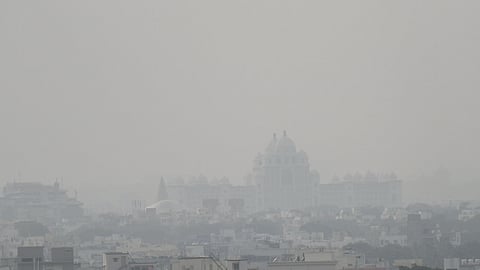

HYDERABAD: Air quality in Hyderabad worsened sharply in December, with the Air Quality Index (AQI) crossing 350 at several locations, prompting experts to warn that the city could face a Delhi-like pollution crisis within five years if urgent corrective steps are not taken.
At Teachers Colony in Secunderabad, the AQI touched 367 on December 23, which is equivalent to smoking about 19 cigarettes a day, according to health estimates.
Experts cautioned that the winter spike is not an isolated event but an early signal of a worsening trend driven by rising vehicular numbers, construction activity and regional emissions.
Dr Gufran Beig, founder and project director of SAFAR and chair professor at the National Institute of Advanced Studies, IISc, said Hyderabad’s peninsular location and relatively warmer winters currently offer some protection, as temperature inversions are weaker than in north India. However, he warned that this advantage is rapidly shrinking.
Environmentalist Purushotham Reddy noted that Delhi’s pollution is worsened by polluted air masses getting trapped by the Himalayas and strong inversion layers, a chamber-like effect not seen in Hyderabad.
Environmental experts stressed that while Hyderabad’s geography differs from Delhi’s, the health risks nevertheless remain severe.

Vehicular emissions aggravate pollution
Dr Darga Shaik, founder of the Centre for Sustainable Environment and Education, said that while Hyderabad may not reach Delhi’s extreme AQI levels of 800–900, readings above 300 are extremely harmful and cannot be normalised.
Dr Beig said vehicular emissions are the largest contributor to Hyderabad’s pollution, accounting for about 45% of PM2.5 levels, with diesel commercial vehicles playing a major role. Emissions from industrial clusters, biomass and coal burning, construction dust, and poor waste management further aggravate the problem.
He emphasised the need for a comprehensive emission inventory and an “airshed approach” covering areas within a 20–40 km radius of the city, warning that measures limited to GHMC limits would have limited impact.
Experts called for aggressive promotion of public transport, restrictions on private vehicles during high-pollution days, improved traffic management and strict enforcement of construction dust control norms.
Beyond immediate measures, Prof Purushotham Reddy flagged governance failures, saying city governments lack adequate authority over transport, waste management and pollution enforcement. Without empowered urban local bodies, he warned, Hyderabad’s quality of life will continue to decline.
Hyderabad’s crossing of the 350 AQI mark may not yet be a Delhi-level emergency, but experts agree it is a critical warning. “This is the stage where Delhi once stood,” Dr Beig said. “Hyderabad still has a chance — if it acts now, scientifically and urgently.”
City to be pollution-free: CM
Hyderabad: Chief Minister A Revanth Reddy declared that there would be a comprehensive overhaul to make Hyderabad pollution-free. Speaking at a review with MAUD officials on Tuesday, he emphasised the need for effective measures to maintain cleanliness. A complete ban on plastic use in the city was also decided upon