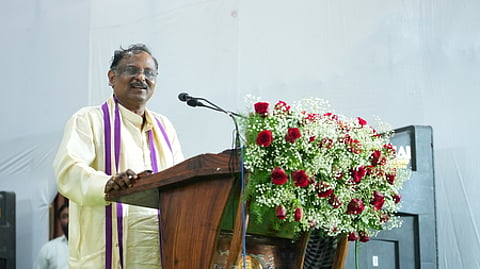

HYDERABAD: ISRO Chairman Dr V Narayanan on Friday said India would need to nearly triple the number of its operational satellites in space, from the current 55 to around 150, within the next three years to meet growing national demand.
Speaking at the GP Birla Memorial Lecture on Indian Space Programme – Accomplishments, Challenges and Future Perspectives, Narayanan said ISRO aims to match global standards in space technology, applications and infrastructure by 2040.
Narayanan was bestowed with the GP Birla Memorial Award at the event.
Recalling ISRO’s achievement in placing 100 satellites in a single launch, Narayanan highlighted how the data accumulated by the organisation benefits everyday sectors such as agriculture and fisheries through accurate weather alerts and resource mapping.
He confirmed that 12 launch vehicle missions are scheduled for this year, including the NASA-ISRO Synthetic Aperture Radar (NISAR), which will be launched using India’s GSLV F16 rocket on July 30.
“Now we are working on building our own space station. We are going to have our own Chandrayaan landing. At present, 55 satellites are in orbit serving the common man. In the next three years, that number has to become nearly three times,” the ISRO chairman said.
Sriharikota to get new launchpad
ISRO chief Narayanan added that the first module of India’s space station will be launched in 2028, with full construction targeted for 2035. The Gaganyaan mission, India’s first human spaceflight programme, is expected to take off in early 2027.
As part of ISRO’s ongoing international collaboration, he confirmed that India and Japan are jointly developing the Chandrayaan-5/LUPEX mission. “We are building the satellite together, and the launch will be conducted by Japan. Chandrayaan-3’s lander mass was 1,600 kg; this will be 6,600 kg,” he said.
ISRO is also preparing to launch a 6,500 kg US communication satellite in the next three months using Indian launch vehicles. In the last decade, the agency has placed 518 satellites in orbit, including 433 foreign satellites from 34 countries.
He noted that space sector reforms are progressing, with ISRO transitioning from a service-oriented model to one that actively pursues commercial opportunities. This includes plans for missions to Venus and Mars, as well as the Samudrayaan project for deep-sea exploration.
Narayanan said the Union government has approved the construction of a third launch pad at Sriharikota at an estimated cost of Rs 4,000 crore.
The ISRO chief also referenced the indigenous development of advanced propulsion systems, including electric and nuclear propulsion, air-breathing engines, and reusable space vehicles.
He also mentioned SPADEX (Space Docking Experiment) and said India had successfully placed a satellite in the Earth’s L1 orbit point in a single attempt.
Reflecting on ISRO’s growth, Narayanan acknowledged the contributions of past scientific leaders including Dr Vikram Sarabhai, Dr Satish Dhawan, and Prof Chitnis, stating that ISRO’s evolution has been a collective effort. (With PTI inputs)
