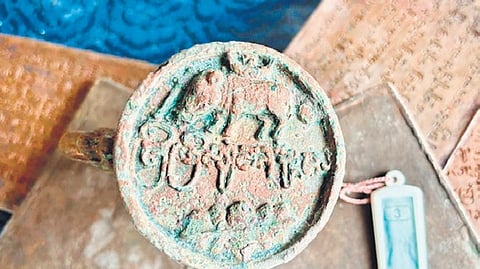

HYDERABAD: Of the nine sets of copper plates related to the Eastern Chalukya dynasty discovered recently in a Muslim graveyard in Kodad, four have been studied, revealing details about royal lineages and the early roots of the Kakatiya dynasty.
The plates, inscribed in Sanskrit using Telugu script, date back to the 9th and 10th centuries CE. ASI Director (Epigraphy) K Muniratnam Reddy says that these inscriptions not only offer detailed dynastic genealogies of the Eastern Chalukyas but also serve as some of the earliest recorded references to the ancestors of the Kakatiyas, bridging the historical gap between the prominent Deccan powers.
The most recent plate to be studied is a set dated April 22, 921 CE, belonging to King Ammaraja I. It traces the dynasty’s lineage from Kubja Vishnuvardhana to Ammaraja I and records the grant of the village, Pokarani, to the Gundesvarabhattarakaya temple in Kakarti village.
Another set, dated March 6, 918 CE, belongs to Vikramaditya II. It marks the occasion of the king’s coronation and documents the grant of the village Kovuru to Lokamamba, wife of Gunda II, who died fighting alongside Vikramaditya II in a war to reclaim the throne from the ‘usurper’ Talapa.
This plate begins with the prasasti (eulogy) of the Samanta Vetti family, ancestors of the Kakatiyas. It is the earliest known inscription to mention the lineage of the Kakatiya dynasty, listing Samanta Vetti, Gunda I, Erra, and Gunda II.
Supporting education at a temple built by Kakatiyas
The third plate, dated to the reign of Chalukya Bhima I (892-922 CE), records a grant of the village Chunugiyapundi to support rituals, food offerings and education at the Sakalesvara Siva temple in Kakarti village. The fourth, also linked to Bhima I, records that the Sakalesvara temple was originally constructed by Gunda I, further strengthening ties between the Chalukyas and the emerging Kakatiya family.
