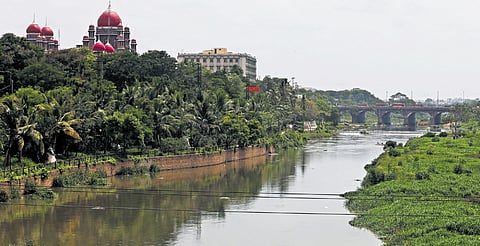

HYDERABAD: With the Asian Development Bank (ADB) expressing its consent to grant a loan, the state government is fast-tracking the Musi Riverfront Development Project.
Of the total 55 km stretch targeted for development, the government plans to initially develop a 20.5 km segment. Work has been intensified under Phase 1A and Phase 1B of the project, which carries a combined estimated cost of `5,641 crore. Specifically, Phase 1A is estimated to cost `2,500 crore and Phase 1B `3,141 crore.
According to a pre-feasibility report on the project accessed by TNIE, Phase 1A encompasses a 9.2 km stretch of the Musi River from Himayatsagar to Bapu Ghat. Phase 1B covers the stretch from Osmansagar to Bapu Ghat.
As part of the project, the government will undertake desilting of the river to a depth of two metres. This will be complemented by physical infrastructure, including flood control embankments, pumping stations, flood walls, flood monitoring buildings, and flood-proof decks.
The total land required for Phases 1A and 1B is 199.89 hectares. Of this, 137.72 hectares is patta land, while the remaining 62.17 hectares is government-owned. Land acquisition will be carried out in accordance with the Right to Fair Compensation and Transparency in Land Acquisition, Rehabilitation and Resettlement Act, 2013.
A 50-metre buffer zone on both sides of the river has been earmarked for development. This designated area on either bank will be developed as an integral part of the project.
109 hectares proposed for green belt
All existing structures within this zone, such as houses, street vendor shops, and kiosks, will be acquired for the development. Out of the total project land, 109.42 hectares are proposed for a green belt.
This will include a 20-metre-wide green belt along the project’s boundary, with plans to plant more than 500 tree saplings.
Regarding employment, the construction phase is expected to generate 100 permanent jobs and employ as many as 3,000 workers on a temporary basis.
During the operational phase, an estimated 200 permanent positions will be created, with an additional 200 temporary workers hired from local sources.
Projects & features
Green infrastructure: Green Infrastructure like permeable walkways, tree plantation, parks and rain gardens for groundwater recharge, retention ponds and green roofs
Tourist facilities: Public toilets, drinking water facility, paved parking spaces, food kiosks, seating areas, signages, route maps and information boards, landscaped promenade
Recreational: Light & Sound show, water sports, mela grounds, cultural haat, etc.
Digital: Digital AV guidebooks, smart parking system, environmental monitoring devices, intelligent traffic and security management
Sustainability: Non-motorised route planning (green drive plans), solar panelling, seating and newly developed structures, electric rickshaws and battery-operated vehicles
