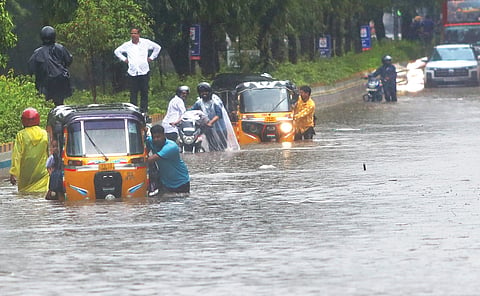

HYDERABAD: The 2025 monsoon in Telangana has been nothing short of extreme. Early showers gave way to weeks of punishing dryness, only for sudden downpours to drown Hyderabad’s streets. These erratic patterns reveal how climate change and rapid urbanisation are rewriting the rules of the region’s weather, and scientists warn this may be the new normal in an era of rising temperatures and expanding cities.
When the southwest monsoon reached Telangana in early June, farmers had already begun preparing their fields, and reservoirs were poised to recharge, while the India Meteorological Department (IMD) projected a fairly active season. But within weeks, the state plunged into a long, punishing dry phase lasting nearly 45 days.
Daytime temperatures soared 2–4°C above normal, heating the skies enough to trigger towering cumulonimbus clouds, which are capable of lightning, hazardous winds, large hailstones, and even tornadoes. These dramatic clouds became a frequent sight over Hyderabad and neighbouring districts, unleashing sudden, furious bursts of rain without warning.
Unlike traditional monsoon systems that can be tracked days in advance, these heat-driven storms erupted suddenly, drenching isolated pockets and overwhelming the city’s fragile drainage system. IMD officials noted that much of the rainfall in the first half of the season came not from organised low-pressure systems but from cumulonimbus clouds.

By late July, the Bay of Bengal finally stirred. Four to five low-pressure systems formed and moved inland, drenching Telangana with widespread rain. The state’s rainfall swung sharply, climbing from a 30 per cent deficit to a 25 per cent surplus by September.
While rural areas welcomed the respite, Hyderabad faced a different reality. Evening showers, amplified by the city’s urban heat island effect, where buildings trap heat and create pockets of higher temperatures, channelled more moisture into the city, turning streets into rivers and flooding entire neighbourhoods.
Five-year trends
The unusual behaviour of the 2025 monsoon cannot be viewed in isolation. Rainfall data from the past five years highlights a clear trend: greater variability in both the amount and timing of rain has become the new normal in Telangana.
In 2021, Adilabad topped the charts with 1,468.1 mm of rain, while Hyderabad logged 845.3 mm. In 2023, Hyderabad recorded 821.7 mm, even as Medak, Hanamkonda, and Nizamabad all crossed 1,100 mm. Then came 2024, a year of extremes—Bhadradri Kothagudem soaked in 1,425.7 mm, while Nalgonda had only 542.1 mm.
Now in 2025, early IMD data show that Hyderabad has already crossed 800 mm. But here lies the problem: the rainfall has been crammed into fewer days, resulting in widespread flooding across multiple localities.
Scientists warn that this is the real story. While total annual rainfall may not have changed drastically, the number of rainy days has plummeted, concentrating water into fewer, more violent spells. For semi-arid states like Telangana, where natural drainage and civic infrastructure are not designed to absorb such shocks, this trend is especially dangerous.
Adding to the urgency are record-breaking events in recent years. In 2023, Jayashankar Bhupalpally witnessed a staggering 65 cm of rainfall in just one day — one of the heaviest downpours in the state’s history. In 2024, Mulugu received 44 cm in a single day, while on September 1 that year, more than 24 stations across Telangana logged over 20 cm. Mahbubabad alone recorded 40 cm. These figures reveal a worrying escalation in the scale and intensity of extreme weather.
Why is this happening?
Behind Telangana’s turbulent monsoon lies a complex mix of climate change, urbanisation, and environmental neglect. Dr Nagaratna, IMD Hyderabad director, noted that extreme weather events are clearly on the rise. “While rainfall amounts are increasing, the number of rainy days is decreasing,” she explained. “This paradox is driven largely by global climate patterns such as El Niño, La Niña, and the Indian Ocean Dipole (IOD).”
Dr Nagaratna explained that a positive Indian Ocean Dipole (IOD), when the western Indian Ocean warms more than the eastern part, tends to strengthen India’s monsoon, while a negative IOD weakens it. “These phenomena lead to inter-annual variability, which is why one year can be wetter and then drier,” she added
Hyderabad has witnessed such swings before, notably in 2015–16, as part of cycles that tend to repeat every eight to nine years. But the recent extremes tell a different story.
Urban heat island effect
If global climate drivers explain the big picture, Hyderabad’s own transformation explains the local intensity.
Deforestation has worsened the imbalance. The result: even modest rains now trigger floods. IMD-Hyderabad GNRS Srinivasa Rao added that 2025 marked an acceleration of these changes. “The change was slower since 2021, but this year we are seeing sudden, intense rainfall in isolated pockets,” he said.
During the long monsoon break, cumulonimbus clouds—usually pre-monsoon features—dominated skies. The anomaly stemmed from unusually high surface temperatures, even as May recorded the lowest pre-monsoon temperatures in 25 years due to multiple upper-air circulations.
He explained that rapid urbanisation is reshaping local weather patterns, causing rains that would normally fall in surrounding districts to converge over the city by evening. This convergence fuels the formation of towering cumulonimbus clouds, rising up to 18 km high, which then unleash intense storms resembling cloudbursts, though triggered through a different mechanism.
Adding another perspective, Ashok Karunuri, professor at the University of Hyderabad’s Centre for Earth, Ocean and Atmospheric Sciences, explained how climate change operates over decades. “Temperatures are increasing, leading to more heat waves, warmer days, and warmer nights,” he said.
Karunuri noted that rainfall, however, is more complex. Warmer air holds greater amounts of moisture, which delays condensation but results in more intense rain once saturation occurs. This combination has made heavy downpours increasingly common.
He flagged a worrying cycle: intense downpours often deplete atmospheric moisture quickly, leading to alternating spells of floods and extreme heat. This rhythm, he said, will only grow sharper in the years ahead.
Hyderabad: A city at breaking point
Hyderabad, once known for its rocky terrain and mild climate, has become a frontline victim of both climate change and poor planning. Dr Rajeswar Jonnalagudda, head of climate change and training at EPTRI, explained the broader timeline. “Since the Industrial Revolution, global average temperatures have already risen by about 1–1.5°C and are projected to cross 1.5°C by 2030. If warming exceeds 6°C, it could drive intense evaporation and, in turn, much heavier rainfall,” he said.
He noted that the annual rainfall total has not changed dramatically, but the rainy days have. Telangana should ideally have 25–30 rainy days a year. Now, that figure has dropped below 20.
Urban expansion, he stressed, is compounding the danger. The blasting of Deccan rocks, loss of green cover, and unchecked sprawl have weakened the city’s natural resilience. “Climate change itself is slow, but it induces disasters,” he said.
The city, he warned, must brace for harsher summers, food supply chain disruptions, and greater infrastructure strain.
On adaptation, Dr Rajeswar argued for decentralised development and reverse migration to reduce pressure on megacities. Stronger public transport, greener economic models, and environmentally friendly planning are vital. He praised Telangana’s HYDRAA initiative for integrated urban management, suggesting it could serve as a model for other Indian cities.
Coping with floods
For Hyderabad, the monsoon is no longer just about rainfall—it is a civic stress test. Joel Davis, Joint Commissioner of Police (traffic), described how the city prepares. “We get weather inputs from IMD and weather bloggers, and we have historical data from waterlogging points. If it’s a 4 cm rain, we know the vulnerable spots. If it’s beyond 8–9 cm, we know which areas will be waterlogged,” he explained.
Emergency teams are deployed accordingly, with pumping machines on standby and drains desilted in advance. Yet even with such measures, prolonged waterlogging often lingers. “In some places, we had four to five hours of waterlogging even after rains reduced. We had no choice but to keep manpower there to reassure drivers,” Davis said. Social media has become a tool to keep commuters informed in real time.
Still, he admitted, bigger changes like promoting public transport and reducing private vehicles lie outside the scope of flood management but are crucial for long-term resilience.
HYDRAA Commissioner AV Ranganath linked the city’s flooding to its vanishing water bodies. “Many lakes in the core city have disappeared or been encroached. About 61% are encroached, and only 39% remain,” he said.
Protecting and rejuvenating what is left has become a priority. Streams, too, have vanished. Reviving them, desilting nalas, and restoring open drains are vital, he argued. “We have almost 51 HYDRAA DRF teams and 150 monsoon emergency teams, totalling 201, and plans to increase further,” he said, adding that involving citizens through social audits would improve accountability.
What the future holds
The consensus among scientists, civic officials, and environmentalists is clear: Hyderabad and Telangana must prepare for more erratic monsoons, heavier rains, harsher summers, and worsening urban floods.
Even a half-degree global temperature rise could translate into 3–5°C spikes in already hot areas, IMD officials warn. The interplay of global climate drivers and local urban heat islands will make forecasting more complicated.
Academics call for advanced local forecasting tools, more observation stations, AI-driven models, and micro-level data integration. Environmentalists stress the urgency of cutting emissions, halting deforestation, and restoring biodiversity. Civic leaders focus on lake rejuvenation, upgraded drainage, and stronger citizen participation.
For Dr Rajeswar, the stakes go far beyond science. Climate change is not just an environmental issue—it is a matter of justice and survival. India, despite its relatively small historic emissions, bears a disproportionate burden, and cities like Hyderabad, caught between global warming and local mismanagement, must adapt quickly or risk disasters becoming the new normal.
However, the monsoon of 2025 has made one thing certain: Telangana’s climate has entered uncharted territory. Extremes, variability, and unpredictability are now the defining features of rainfall. Five years of data underline this truth, and the lived experience of Hyderabadis—streets flooded after even modest showers—drives it home.
Experts agree on one sobering point: climate change is real, it is here, and it is accelerating. The state’s future will hinge on how swiftly it can rethink its planning, infrastructure, and governance in the face of an era defined by extremes.
Changing seasons, rising risks
Environmentalist Donthi Narsimha Reddy highlights a worrying shift in Telangana’s weather patterns. He explains, “Usually Hyderabad used to have rains only in July and August, but now they extend to September and October,” he observed.
Depressions from the Bay of Bengal, aided by the Arabian Sea branch of the monsoon, are bringing rain more frequently. Telangana, a semi-arid and water-stressed state, is now witnessing floods—a paradox that still surprises seasoned observers.
Narsimha Reddy pointed to the culprits: carbon emissions, deforestation, biodiversity loss, and what he called the “chemicalisation” of agriculture and industry. He warned that the next two to five years will only bring greater uncertainty, with climate calamities becoming routine