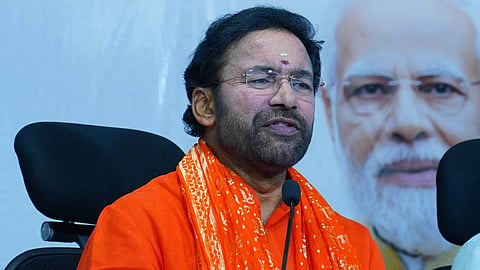

HYDERABAD: Stating that the demand for EV batteries and renewable energy tech is likely to increase three times by 2030, Union Coal & Mines Minister G Kishan Reddy on Tuesday said that the country needs a strong research and development ecosystem that will help in fulfilling the needs of the future.
“Our scientists, engineers and industry partners will work together to innovate in exploration methods, processing of rare earths, recycling of batteries and developing next-generation materials,” he said.
The Union minister was addressing the gathering after launching the sixth tranche of auction of critical and strategic minerals in Hyderabad. He also presided over a seminar on National Critical Mineral Mission.
Kishan said that under the National Critical Mineral Mission, the Union Cabinet approved a Rs 1,500 crore financial incentive scheme to boost the country’s recycling capacity. “This initiative will attract investments worth around Rs 8,000 crore and create close to 70,000 jobs,” he added.
“The recent export restrictions and geopolitical challenges have highlighted the importance of indigenous technology in securing our critical mineral supply chain. As we strive to become the third largest economy and a developed nation by 2047, Atmanirbharta in critical minerals will play a key role,” he added.
Kishan said that in the last few years, India achieved many records in the coal and mining sector. “For the first time, we achieved one billion tonnes in coal production and sales,” he said.
“Earlier this year, we launched India’s first-ever auction of exploration licence blocks with the idea of speeding up exploration and ensuring greater private participation. A total of 23 blocks are put up for auction. States including Telangana, Punjab, Uttarakhand and West Bengal are bidding for the critical minerals blocks auction for the first time,” he added.
“I am proud to say that in just a few months, we are moving at a remarkable pace on all seven pillars of this mission — be it increasing domestic production, securing assets abroad, building value chains through processing and skilling, promoting recycling, creating strategic stockpiles, enhancing trade and international cooperation and supporting R&D and innovation through centres of excellence,” the Union minister explained.
“India has allocated roughly $4 billion (Rs 34,000 crore) towards these seven pillars. You would be surprised to hear that even the United States till last month did not have such a mission,” he added.
