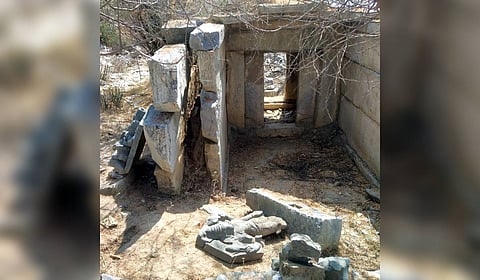

HYDERABAD: Hyderabad-based historian Dyavanapalli Satyanarayana has discovered the ruins of a major ancient settlement on the left bank of the Krishna River in Nalgonda district, along the southern boundary of Veerlapalem–Veerappagudem villages in Dameracherla mandal.
Archaeological evidence suggests the settlement dates back over 3,000 years and remained inhabited until the 15th century CE. The exploration revealed hundreds of Iron Age megalithic burials, or cairns, locally believed to be the graves of warriors, which is reflected in place names such as Veerulapadu and Veerappagudem.
Explaining the significance of the site, Satyanarayana told , “The perennial Krishna River provided abundant water, fish and natural resources, enabling a flourishing settlement. Iron slag found at several locations suggests local iron production capable of working large stone blocks. The burials were constructed with four large upright stones capped by a flat slab. While similar megalithic sites along the Krishna have yielded valuable insights through earlier excavations, this site has so far escaped the attention of the Archaeology department.”
He noted that the burial stones, locally known as Banjar Raallu (Palnadu stone), are abundantly available in the area, which led to the establishment of a cement company around 50 years ago. Extensive quarrying by the company and locals, along with destruction by treasure hunters, has resulted in the near disappearance of these burials, posing an imminent threat to the remaining structures.
After the megalithic phase, evidence of habitation is sparse for nearly a millennium. However, from the medieval period, between the 10th and 15th centuries CE, remains of fort walls, bastions, granaries, temples, wells, houses and sculptures are clearly visible at the site.
Satyanarayana further explained,“A square fortification measuring about 70 × 70 metres, with a main southern entrance overlooking the Krishna River, stands at the site. The remains include foundations of a key structure and a tall southeastern bastion that likely served as a watchtower. Damaged shrines and sculptures of Vanadurga, Pochamma, pothuraju, Veerabhadra or Bhairava, along with several hero stones, are found to the northeast. Architectural features date the site to the period between the Kanduri Cholas and the Recherla Padmanayakas.”
“Local tradition associates the fort with Kakatiya queen Rudramadevi, believed to have used it as a grain storage centre, supported by large lime-plastered circular granaries. The absence of domestic pottery suggests the site functioned mainly as a protected granary rather than a residential settlement,” he added.
In the extended stretch of the Krishna riverbank, about a furlong south of the fort, historians found the ruins of a Lakshmi Narasimha temple from the Recherla Padmanayaka period, dating to the 14th–15th centuries CE. Broken idols of Lakshmi Narasimha, Adi Lakshmi and Chenchu Lakshmi were recovered and reassembled by Satyanarayana, while Garuda carvings on the pedestal and a nearby Dasanjaneya sculpture point to Padmanayaka patronage.
Satyanarayana urged the Archaeology department to urgently document the site in view of extensive quarrying in the region, terming it essential for conservation.
