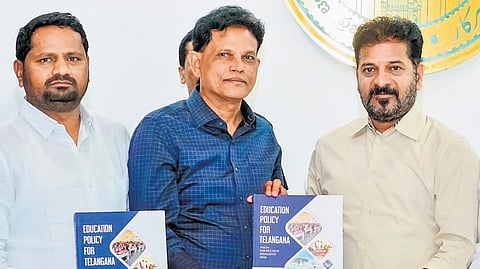

HYDERABAD: Declaring education a state mission, allocating at least 18% of the state Budget to the sector and basing education spending on actual annual infrastructure and maintenance needs are among the key recommendations in Education Policy for Telangana 2026: Vision for Inclusive Excellence, submitted by the Telangana Education Commission (TEC) to Chief Minister A Revanth Reddy.
The policy document was submitted on Thursday by TEC chairman Akunuri Murali and other members of the Commission.
The document is structured into 12 chapters and contains recommendations covering pre-school, school, Intermediate, technical, collegiate and university education. It also includes provisions for open and distance learning, along with regulatory and legislative reforms aimed at streamlining governance across the education sector. Each chapter specifies standard infrastructure requirements to ensure access to globally competitive education across Telangana.
Explaining the recommendations, the TEC proposed that at least 18% of the state Budget be allocated to education, including 5% for higher education. It noted that earlier Budgets had allocated around 9% to the sector.
The Commission also recommended that education budgets be linked to real annual infrastructure and maintenance needs, instead of being largely limited to salaries and pensions. It further stated that education should remain free from communal, caste, gender or majoritarian bias, while upholding constitutional values and diversity.

Outlining proposals relating to school, Intermediate and higher education, Murali said the policy recommends establishing Telangana Public Schools—large, fully equipped campuses offering education from pre-primary to Grade 12 under one roof, with transport facilities. These schools are intended to address multigrade teaching, teacher shortages and infrastructure gaps.
The policy proposes restructuring B.Ed. programmes into B.Ed. (Primary) for pre-primary to Class V and B.Ed. (Secondary) for Classes VI to XII.
It also recommends amending existing laws or enacting new legislation to empower the Board of Intermediate Education to register and regulate private coaching centres for competitive examinations such as JEE and NEET, along with hostels attached to them.
Fee regulation, coaching curbs in new education plan
Regulation would cover fees, infrastructure, faculty, curriculum, student mental health and misleading advertisements. Competitive exam coaching would be restricted to legal entities established solely for that purpose, and junior colleges recognised for Intermediate education would be barred from offering such coaching.
Other recommendations include abolition of the Intermediate first-year public examination, discontinuation of EAPCET, merger of the SSC and Intermediate Boards into a single Telangana Secondary Education Board, and raising the minimum pass percentage to 45% from the existing 35%. The TEC also recommended suspension of fee reimbursement for consistently underperforming private institutions and revocation of recognition for violation of norms.
It advocated English as the medium of instruction from nursery to university level, with a three-language system — Telugu or Urdu, English and Hindi — to be implemented from Class I onwards. The TEC suggested that appointments of university vice-chancellors be made through a transparent process involving a search committee comprising a retired chief secretary, a UGC nominee and three retired vice-chancellors.
The policy also calls for abolition of the self-financing system in universities.
Responding to the presentation, the chief minister said the state government would upgrade 200 schools across 100 mandals in 100 constituencies in the next academic year. These would be developed into full-fledged Telangana Public Schools offering education from nursery to Class XII with all facilities. He assured that the required Budget would be allocated in the forthcoming financial year.
The TEC said the state government would review the recommendations in detail before incorporating them into the final policy document. If implemented, the proposals would lead to a wide-ranging overhaul of the education sector.
Add milk to school breakfast: CM
Chief Minister A Revanth Reddy, during a review of the Education department at the ICCC, discussed rollout of breakfast in government schools from 2026–27 and directed milk be provided to every student, procured from Vijaya Dairy