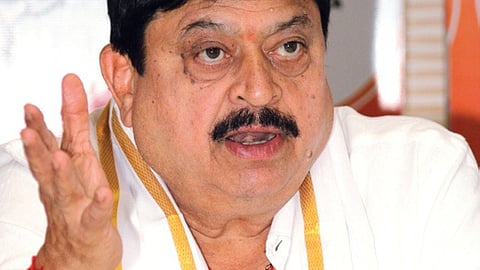

HYDERABAD: State BJP president N Ramchander Rao on Friday described the verdict of the Rouse Avenue Court discharging AAP chief Arvind Kejriwal, Telangana Jagruthi leader Kalvakuntla Kavitha and others in the Delhi excise policy case as being based on “technical and procedural grounds” rather than on the merits of the allegations.
“Discharge on technical grounds is not proof of innocence,” he said.
Ramchander was addressing the media at the BJP state office after Dr Anoop joined the party in the presence of BJP MP Dharmapuri Arvind. The order was delivered by a trial court and further legal steps by the CBI were yet to be taken, he pointed out.
The BJP leader maintained that the court had allowed the discharge petitions due to procedural lapses and not because the allegations lacked substance. “This is not a clean chit on merits,” he asserted.
Raising questions over the sequence of events in the case, Ramchander asked why mobile phones were allegedly destroyed if there was no incriminating material on them. He also questioned why the Delhi liquor policy was changed and later reversed.
According to him, it was the Congress party that first lodged a complaint regarding the Delhi Excise Policy in 2022, following which the Enforcement Directorate and the CBI stepped in during 2024.
He stressed that the discharge order did not amount to an acquittal after a full-fledged trial and reiterated that the matter could see further legal scrutiny.
Turning to state politics, the BJP leader claimed that intellectuals and educated sections in Telangana were increasingly gravitating towards the BJP, reflecting what he described as growing public confidence in the party’s ideology and its vision for national development.
Referring to remarks made by AIMIM leader Akbaruddin Owaisi alleging that Uttar Pradesh Chief Minister Yogi Adityanath and Telangana Chief Minister A Revanth Reddy were anti-Muslim, Ramchander dismissed the comments as part of a “political drama” and termed them “cheap political comments”.
He recalled that during an earlier election campaign, Revanth had publicly stated that “Congress is Muslims and Muslims are Congress” and had also described the Congress as a Muslim party. According to Ramchander, such statements reflected the political character of the Congress.
Alleging a tacit understanding between the Congress and the AIMIM, he said that as people were beginning to see the closeness between the two parties, the chief minister, fearing political backlash, had allowed Akbaruddin Owaisi to make provocative remarks to create an impression of hostility between them.
He claimed that Akbaruddin and Revanth shared a close political understanding and were, in fact, “political friends.” Publicly, he alleged, they attempted to portray themselves as adversaries.
Ramchander asserted that Akbaruddin had never genuinely spoken against either the Congress party or the Chief Minister and that there was a clear political understanding between the two, which he said explained what he described as Congress “support” to the AIMIM.
The BJP leader also questioned why a college run by the Owaisi family, located within the Full Tank Level area of a lake in the Old City, was not being demolished as part of the ongoing drive against constructions in buffer zones of canals and lakes. He alleged selective action in the implementation of demolition drives.
Accusing the Congress and AIMIM of misleading the public with false promises, Ramchander reiterated his charge that Revanth and Akbaruddin were political allies and that their public differences were aimed at confusing the voters.