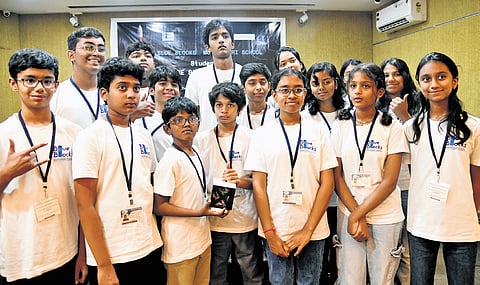

HYDERABAD: Aerospace has long been seen as an adults-only domain. A classroom in Hyderabad has now shattered that belief. This Monday, when ISRO’s PSLV-C62 lifts off, it will carry a flight-ready CubeSat payload designed and built by students aged just 12 to 15.
As many as 17 students from Blue Blocks Montessori School, Hyderabad, have designed and assembled Project SBB-1 (Satellite Blue Blocks-1), a CubeSat payload officially manifested for launch aboard ISRO’s PSLV-C62 mission. The project marks a rare milestone in school-level science education, placing middle-school students at the centre of a real space mission.
The CubeSat, a 10×10 cm miniaturised satellite payload, was developed over nearly two-and-a-half years of ideation, followed by five months of hands-on assembly and testing. Scientists from Hyderabad-based space startup firm, TakeMe2Space, provided technical guidance, while the students independently handled design, integration and execution.
Explaining the payload, Class 8 student Ashrith Rudraraju said the CubeSat collects raw data using sensors such as accelerometers and gyroscopes to determine orientation, magnetic field strength, temperature, humidity and pressure in space. He added that such data can aid climate studies, disaster prediction and agricultural monitoring, including crop health and water use.

Class 7 student Aahan Hemal Mehta recalled early challenges. “When the sensors didn’t work initially, we checked every line of code and connection to fix the problem,” he said.
The excitement of seeing their work ride a rocket is palpable. “Most of us have never seen a rocket launch. We didn’t want to just watch one; we wanted to be on it,” said another student, Saachi Goyal.
Anand Rajagopalan, executive vice-president of TakeMe2Space, said the students were guided to think like engineers rather than given ready-made solutions. “Once they understood how a satellite works and why certain design choices matter, they planned their own mission. Our role was to guide, not supervise. The initiative always remained with them,” he said.
Unlike typical school STEM projects, SBB-1 involved no kits or simulations. Students designed the payload from first principles, integrated and soldered commercial sensors, and wrote firmware for real-time telemetry. Teacher intervention during engineering tasks was deliberately minimised to ensure first-hand learning, said Blue Blocks co-founder Pavan Goyal.
Goyal and co-founder Munira Hussain travelled to IN-SPACe, Ahmedabad, to complete final administrative clearances for integrating the student-built payload with the launch vehicle. The student team has also been selected to present its CubeSat technical review at the AMI Conference in Mexico, placing their work before an international audience of educators.
“This mission is not just about sending a satellite into space,” Munira Hussain said. “It’s about helping children find their place in the universe. When students are trusted with real responsibility, they rise to it.”