
HYDERABAD: A comprehensive 11-year study has documented remarkable bird diversity at the Professor Jayashankar Telangana State Agricultural University (PJTSAU) campus in Hyderabad, highlighting the ecological richness of the semi-arid agricultural landscape in Telangana. The research recorded 92 bird species across 12 orders and 31 families.
The largest representation came from the order Passeriformes, which included 50 species, ranging from bulbuls, babblers and drongos to sunbirds, sparrows and weaverbirds. Species such as the Indian myna, red-vented bulbul, magpie robin, black drongo and common babbler were among the most abundant and frequently sighted birds across the campus. Their adaptability to mixed habitats, including croplands, hedgerows, tree canopies and built structures, allows them to remain active throughout the year. Many of these passerines play a crucial ecological role by feeding on insects, thereby contributing to natural pest control in experimental crop fields.
Of the total species recorded, 40 species (43.5%) were resident birds, 41 species (44.6%) were residents with local migratory movements, five species (5.4%) were local migrants and six species (6.5%) were winter migrants.
The study also recorded Columbiformes such as blue rock pigeons, spotted doves and ring doves, commonly observed foraging on seeds and grains in open fields. Psittaciformes such as rose-ringed and blossom-headed parakeets were frequently seen in flocks during crop maturation stages, often causing localised crop depredation due to their strong beaks.
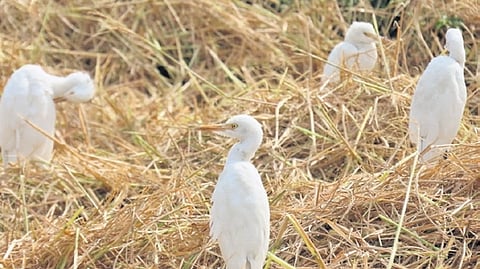
Wetland-associated species such as cattle egrets, pond herons and little egrets were recorded near farm ponds and irrigated fields, often feeding on insects disturbed during ploughing. Raptors like the pariah kite and Brahminy kite indicated a healthy trophic structure, while owls helped control rodent populations.
Bird activity peaked during early morning and late evening, with roosting in neem, banyan and tamarind trees. While many species aid agriculture, nine crop-depredating species were identified. Researchers, however, emphasised that only a small fraction act as serious pests.
Meanwhile, World Wildlife Day was celebrated at the Mahavir Harina Vanasthali National Park in Hyderabad on Sunday
