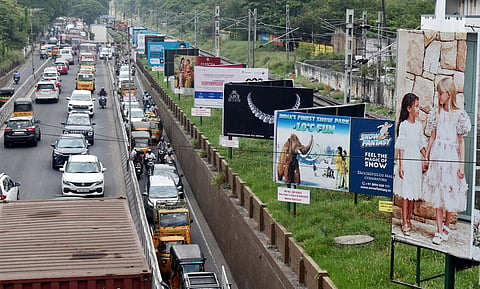

HYDERABAD: The state government has approved a Comprehensive Outdoor Advertisement Policy for the Core Urban Region (CURE), introducing stricter regulations, zoning norms and technology-based monitoring of hoardings and outdoor advertisements across the Hyderabad metropolitan area.
Issued through a GO, the policy will apply to CURE across the jurisdictions of GHMC, Cyberabad Municipal Corporation and Malkajgiri Municipal Corporation. It replaces all earlier guidelines and seeks to establish a uniform regulatory framework.
To strengthen monitoring and transparency, every permitted advertisement must display a QR code linked to permit details such as validity, dimensions and location. All advertisements will also be geo-tagged, enabling real-time tracking.
The government will constitute an Advertisement Regulatory Committee (ARC) as the nodal authority to approve and regulate all outdoor advertisements in CURE. No advertisement will be allowed without ARC approval. The committee will coordinate with departments and agencies, approve zoning plans and examine location-specific proposals to ensure uniform implementation.
Areas have been classified into four zones: Zone S (high-density premium areas such as central business districts and major transit hubs), Zone A (developing commercial zones), Zone B (mixed-use areas) and Zone C (developing residential areas with lower advertising potential).
Advertisement rights, particularly on public spaces and government infrastructure, will be allotted mainly through open auction or tender. The standard allotment period is capped at five years, though longer tenures may be permitted in public-private partnership projects with government approval. Applications for self-advertisements on private properties and vehicles can be submitted online, with permissions also limited to five years.

The GO places responsibility on civic body commissioners and heads of departments to prevent unauthorised advertisements. Illegal hoardings may be removed without prior notice. Violations are prosecutable, though first-time offenders may compound the offence by paying three times the annual fee and submitting an undertaking not to repeat it. Repeat violations will lead to prosecution and blacklisting.
If payments are delayed beyond 30 days, authorities may forfeit the bank guarantee furnished by the advertising agency and cancel permissions. The policy restricts advertisement locations, banning hoardings on heritage structures, religious places, parks, water bodies, schools, graveyards and other notified public spaces. Advertisements obstructing natural light, ventilation or creating traffic risks are prohibited.
Permitted formats include billboards, unipoles, advertisements on bus shelters, metro infrastructure, wall paintings, temporary banners and advertisements on moving vehicles. Digital and LED displays are allowed with restrictions, including static content changes every 10 seconds and switching off after 11 pm, except in designated night-time economy zones.