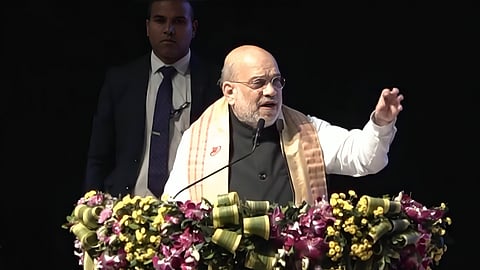

LUCKNOW: With Union Home Minister Amit Shah playing a pivotal role in steering the BJP’s preparations for the 2027 Uttar Pradesh Assembly elections, the party has begun putting its electoral machinery in motion, with seat-sharing negotiations with NDA allies emerging as one of its first major challenges.
Shah is expected to take a central role in overseeing the BJP’s strategy in the politically crucial state, with a proposed plan for him to spend at least seven days every month in Uttar Pradesh to closely monitor organisational preparations and political developments.
The move is aimed at ensuring coordination between the central leadership, the state unit and the Yogi Adityanath government towards achieving Mission 2027.
The development follows a two-day brainstorming session in Mathura, attended by the UP top brass, including Chief Minister Yogi Adityanath and BJP national president Nitin Nabin, to deliberate on the party’s roadmap for the 2027 Assembly elections.
The immediate challenge for the BJP is to arrive at an acceptable seat-sharing arrangement with its NDA partners, several of whom have already begun staking claims to a significantly larger number of constituencies.
The party has entrusted four senior state leaders with opening negotiations with individual alliance partners. Chief Minister Yogi Adityanath will hold talks with Rashtriya Lok Dal (RLD) chief Jayant Chaudhary, while Deputy Chief Minister Brajesh Pathak has been assigned negotiations with Apna Dal (S) president and Union Minister Anupriya Patel. Pathak is believed to share cordial relations with both Anupriya and her husband Ashish Patel, who is a minister in the Yogi cabinet.
Similarly, BJP state president and Union Minister Pankaj Chaudhary will negotiate with Nishad Party chief Sanjay Nishad, who has been demanding 30 seats in the alliance. The other Deputy Chief Minister, Keshav Prasad Maurya, will hold talks with Suheldev Bharatiya Samaj Party (SBSP) chief Om Prakash Rajbhar.
“The leaders are expected to assess the allies’ demands, their electoral performance, social base and constituency-level claims before reporting back to the central leadership. However, the final seat-sharing equation will be formulated by the BJP high command,” a senior party leader said.
The seat-sharing exercise is expected to be more complicated than in the 2022 Assembly elections, as the NDA’s footprint has widened with the RLD and SBSP joining the alliance after having contested the previous election alongside the Samajwadi Party (SP).
“Seat-sharing exercise is likely to be more complicated than in 2022 assembly polls because the NDA's footprint has widened with RLD and SBSP joining the alliance after having fought the last assembly election with the Samajwadi Party. Moreover, all the four significant allies are influential in their own might,” said political scientist Prof SK Dwivedi.
The allies, meanwhile, have begun pushing for a larger share of seats. According to sources, Apna Dal (S) is seeking at least 25 seats, the RLD 30, the SBSP 25 and the Nishad Party between 30 and 36 seats. BJP sources, however, indicate that the party may be unwilling to concede more than around 60 seats to its partners collectively.
The BJP’s older allies are also drawing on their previous electoral performances to strengthen their bargaining positions.
Apna Dal (S), which contested 17 seats in the 2022 Assembly elections, won 12, registering a strike rate of around 70 per cent. The Nishad Party contested 10 seats and won six, recording a strike rate of 60 per cent, while some additional candidates associated with the party contested on the BJP symbol.
The RLD, which was then allied with the SP and concentrated largely on western Uttar Pradesh, contested 33 seats but won only eight, registering a success rate of around 24 per cent.
The SBSP, led by Om Prakash Rajbhar, contested 19 seats and won six, with a strike rate of around 31 per cent.
By assigning negotiations to the state’s top leadership, the BJP appears keen to resolve potentially contentious seat claims early and avoid alliance friction closer to the elections.
While Yogi Adityanath will personally handle negotiations with the RLD, a significant player in western Uttar Pradesh, Keshav Prasad Maurya will engage with Rajbhar’s SBSP, which has its principal political base among Rajbhar and sections of the OBC electorate in eastern Uttar Pradesh.
With Shah expected to keep a close watch on the campaign, an early understanding with alliance partners is likely to form the first building block of the BJP’s larger 2027 strategy, ahead of candidate selection, constituency-level planning and campaign mobilisation.
