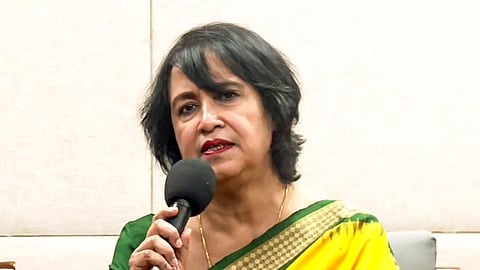

Exiled Bangladeshi author Taslima Nasreen on Wednesday left Kolkata after a six-day visit, and said she would visit the city "whenever it calls me".
Interacting with reporters at the airport before her departure, Nasreen expressed her desire to return to Bangladesh, but said she would stay in India for now as Dhaka had neither renewed her passport nor granted her a visa on her Swedish passport.
"Of course I want to return. I have been in exile for 32 years. But I am not allowed to go back to Bangladesh. It is not that I do not want to return," she said.
"My passport has not been renewed. So, for now, I will remain in India."
Nasreen, who arrived in Kolkata on July 31 after an absence of nearly two decades, said she was leaving the city with "beautiful memories" and was deeply moved by the affection she received from ordinary people.
"I have very fond memories. The love shown by common people brought me to tears," she said, adding that Kolkata had always occupied a special place in her heart.
She indicated that she could return to the city either in October or in January next year.
"Whenever Kolkata calls me, I will come," Nasreen said.
Asked whether she would visit the city during Durga Puja, Nasreen said she was unlikely to be in the city then as she expected to be abroad, but expressed confidence that she would return for the Kolkata Book Fair.
Her visit came 19 years after she was compelled to leave Kolkata following violent protests over her writings.
This was her first trip to the city since 2007.
A day earlier, Nasreen had said deposed Bangladesh prime minister Sheikh Hasina should be allowed to return to Dhaka and participate in the democratic process, while calling for the lifting of the ban on the Awami League ahead of the second anniversary of Hasina's ouster following mass protests.
Her return to Kolkata had also rekindled debate over freedom of expression, secularism and the state's handling of religious sensitivities.
The BJP has projected Nasreen's return as a symbolic correction of what it describes as the failure of successive Left Front and Trinamool Congress governments to protect free speech in the face of religious pressure.
The Left Front and the Trinamool Congress have consistently maintained that the decision to ask Nasreen to leave Kolkata in 2007 was dictated solely by law-and-order considerations after communal tensions escalated in parts of the city.
Organisers of the literary events she attended during the visit repeatedly asserted that the programmes were not political gatherings or government functions, but were intended to reaffirm freedom of expression and oppose religious fundamentalism.
The controversy surrounding Nasreen dates back to November 2007, when protests erupted in parts of Kolkata over her writings, particularly her novel Dwikhandito.
As violence spread through parts of the city, the then Left Front government imposed a ban on the book and asked the author to leave Kolkata, citing security concerns. The restrictions effectively continued during the subsequent Trinamool Congress regime.
(With inputs from PTI)
