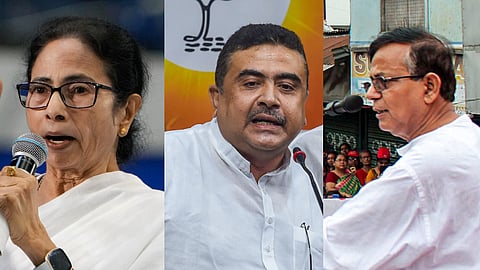

Open rebellions over ticket distribution across parties, combined with the SIR fallout, have added a fresh layer of uncertainty to West Bengal's political landscape, raising questions over cadre cohesion and electoral calculations ahead of the assembly polls.
Soon after candidate lists were announced, both the ruling TMC and the opposition BJP have witnessed protests, resignations, and resentment from cadres and leaders who have been denied tickets- a familiar feature of Bengal elections, but analysts say such resistance may carry greater electoral consequences this time.
The unrest has come at a politically sensitive moment as the Election Commission's Special Intensive Revision (SIR) of voter lists has led to large-scale scrutiny and deletion of voter names, a development political observers believe could alter the electoral arithmetic in several closely contested seats.
From the ruling TMC to the opposition BJP, simmering resentment among disgruntled leaders and grassroots workers has exposed the internal strains that often accompany large-scale electoral reshuffles.
Along with the dissent and organisational friction within parties, the churn in voter rolls could make booth-level mobilisation and campaign cohesion more crucial than in previous elections, the analysts said.
Within the TMC, the scale of candidate reshuffle has been among the most extensive undertaken by the party in recent assembly polls.
The party dropped 74 sitting MLAs, nearly a third of its legislative strength, while announcing candidates for 291 of the 294 seats, signalling a calculated attempt by the TMC leadership to counter anti-incumbency, introduce younger faces and recalibrate local political equations ahead of the high-stakes contest.
In Malda's Harishchandrapur, state minister and three-time MLA Tajmul Hossain accused the party of "betrayal" after he was replaced by Matiur Rahman, who had contested the same seat as a BJP candidate in the 2021 assembly polls.
"I worked for the party for 15 years. Someone suddenly comes and gets the ticket. The party has betrayed me, and it will have to face the consequences," Hossain said. His followers went a step further, alleging that the seat had been "sold for money", a charge the party has not officially responded to.
Further north in Jalpaiguri's Rajganj, MLA Khageswar Roy resigned from his post as district party chairman after the party fielded Asian Games gold medallist Swapna Barman from the constituency.
In North 24 Parganas' Amdanga, protests erupted after three-time MLA Rafiqur Rahaman was denied renomination and replaced by Peerzada Kasem Siddiqui. Supporters blocked roads, burnt tyres and raised slogans demanding that the party reconsider its decision.
"I remain a worker of the party, but I urge the leadership to rethink the decision. I do not know how successful we will be this time," Rahaman said.
Discontent also surfaced in Hooghly's Chinsurah, where the party nominated youth leader and IT cell chief Debangshu Bhattacharya in place of three-time MLA Asit Mazumdar.
Mazumdar publicly expressed disappointment and hinted at withdrawing from politics.
Bhattacharya, however, struck a conciliatory note, describing Mazumdar as "a father figure" and expressing hope he would receive the veteran leader's blessings during the campaign.
The BJP too has faced pockets of resistance over candidate selection.
Party workers staged protests outside the BJP's state headquarters in Kolkata after the announcement of the second list of candidates, alleging that grassroots leaders had been overlooked while selecting nominees. Some protesters warned they would not allow campaigning by certain candidates unless the leadership reconsidered its choices.
BJP state president Samik Bhattacharya said, "We understand the sentiment of our workers, but the decision of the central leadership is final, and all of us have to abide by it."
Even the CPI(M), traditionally regarded as a highly disciplined organisation, has witnessed signs of internal friction. In Nadia's Kaliganj, a section of its workers vandalised a local party office after the Left Front nominated Sabina Yasmin, the mother of a child killed in poll-related violence last year, as its candidate. The party later expelled seven members for their involvement.
Political analysts say potential electoral consequences of ticket-related dissent may be sharper this time because of the simultaneous churn in voter rolls under the SIR exercise.
Data compiled across the state's 294 assembly constituencies suggests that in more than 200 segments, the number of voters affected by deletions or placed under scrutiny during the revision process exceeds the victory margins recorded in the 2024 Lok Sabha elections.
In at least 120 assembly constituencies, the number of deleted voters alone is higher than the Lok Sabha leading margin in those seats, while in around 40 constituencies it exceeds the margins recorded in the 2021 assembly polls.
"In a scenario where victory margins are narrow, the strength of booth-level organisation becomes decisive. If sections of local leaders or cadres remain inactive because of resentment over ticket distribution, it can influence turnout and mobilisation," political analyst Biswanath Chakraorty said.
In the 2021 assembly polls, the TMC won around 45 seats with margins of less than 8,000 votes, while the BJP secured nearly 20 segments within similar margins, underlining how relatively small shifts in votes can determine outcomes in a tightly contested election.
For the TMC, the leadership is banking on Mamata Banerjee's personal popularity and welfare-driven messaging to override local resentment, while for the BJP, seeking to expand its footprint after emerging as the principal opposition in 2021, maintaining organisational cohesion across districts will be crucial.
West Bengal will go to the polls in two phases on April 23 and 29.
