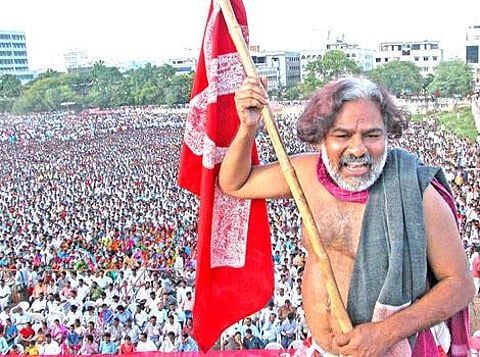

Told by Prof G Haragopal
Although he was not trained in alternative politics, folklore or music in his education given his background, Gaddar effectively communicated the message that he wanted to communicate to the people through the medium of song. Everything he learnt from the people shaped his personality. He was such a keen observer. He used folk songs in the most creative way to communicate the politics of change or transformation.
Gaddar passed away at a private hospital in Hyderabad on Sunday due to a heart-related ailment. While we give lectures, his mode of communication was completely people-centric. And, because of the content of his songs, he was able to reach lakhs of people, if not thousands. Once Vavilala Gopala Krishnaiah, a renowned freedom fighter, told me that Gaddar was the most powerful communicator after Mahatma Gandhi, who also communicated in an ordinary language.
I had interacted with him at a personal level since the 1970s. I was a student union advisor at Kakatiya University. The Radical Students Union (RSU) used to win the elections and they were very keen on inviting Gaddar to their annual meetings. There used to be a lot of pressure from the university, police and government not to have meetings with Gaddar. However, the students’ union used to organise the meetings which would be attended by thousands of people from neighbouring villages as it was not just confined to students.
Gaddar’s performance would start after 9 PM and run till 4 AM. He had a lot of sense of humour. In the middle of songs, he would crack a joke. He would write a song on the broom as the theme and from that he would communicate a revolutionary message.
Once, he wrote an evocative song on the Brahmaputra river. I haven’t seen the river but I could envision a vivid picture of the river, after listening to it. Likewise, he would describe the forest, poverty, sufferings of people, Dalit, Adivasi and a wide range of issues.
When I used to run a postgraduate diploma in Human Rights in the University of Hyderabad, I invited Gaddar and I told him to sing six songs on child labour, migrant labourers, workers, Dalits, and Adivasis. Though the students listened to lectures from judges and professors, it was Gaddar’s message that would ring in their minds.
The State thought this man would become a big problem because he was transforming thousands of people in no time, and attempted to assassinate him. He used to tell us there was a bullet in his body. Society made an experiment communicating messages, and Gaddar was the successful medium, I would say. The artist has no death, he will live on.
