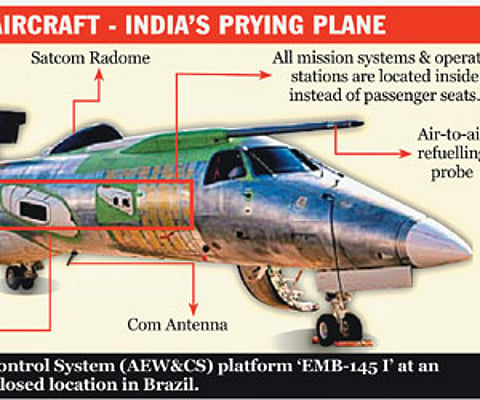

BANGALORE: India’s prying plane is ready. Called the Airborne Early Warning & Control System (AEW&CS), this tech beast comes in the form of a modified Embraer aircraft (EMB-145 I). Sources confirm to The Sunday Standard that the first flight is officially scheduled on December 7 in Brazil. The Centre for Air Borne Systems (CABS), a Bangalore-based less-talked-about wing of the Defence Research and Development Organisation (DRDO), is developing systems to make the EMB-145 I a mean machine.
The Indian Air Force (IAF) will receive three such platforms in the next three years. The integration on ground-based systems on the lines of specifications, including the seating arrangements, is currently on at CABS. The first aircraft will make a touchdown in Bangalore coming June, with the second and third expected in October 2012 and December 2013 respectively. “They (CABS) will need at least six months to integrate the sub-systems (total seven), after the first EMB-145 I arrives,” sources said.
Once operational, India will join an exclusive club of nations owning home-grown eye in the sky systems. Currently, Wedge Tail (USA-Boeing), Phalcon (Israel-IAI) and Erieye (Sweden-Ericsson) are world leaders in prying-from-the-top technology. India had inked a pact with Brazil in 2008 to modify the Embraer so as to integrate the Active Array Antenna Unit (AAAU) on the aircraft’s fuselage. The platform could detect, identify and classify threats present in the surveillance areas and act as a command and control centre to support air operations. The project comes with an updated price tag (to include new features for the IAF) of `2,157 crore.
In an extremely crisp response to this paper’s email query, CABS Director S Christopher could only confirm that an Indian delegation was travelling to Brazil in the first week of June. When this correspondent spoke to G Elangovan, DRDO’s Chief Controller (Avionics) in Delhi, he said that the EMB-145 I would be a very cost-effective and cheapest platform, carrying mission systems, radar, communication units and electronic warfare systems.
The EMB-145 I will boost India’s network-centric warfare capabilities. Apart from surveillance duties, it could track aircraft, UAVs and even detect radar signals. It has the ability to scan up to 400 km, giving the IAF recognised air situations thereby enabling battle field management. The aircraft can operate with a maximum crew of 12 people, including operators, rest crew, pilot, co-pilot and flight test engineer. It can fly non-stop for 10-12 hours with mid-air-refuelling. Sources say that the DRDO has launched a massive name-hunt, before its baby enters Indian air space
in June.
DRDO’s earlier attempt to make a surveillance platform (Project Guardian/Airawat) had met with disaster when the HS-748 turboprop test-bed aircraft crashed in 1999, killing several scientists and engineers.
