
The picture of Mahatma Gandhi spinning on his charkha in his ashram is one of the most enduring images of the freedom struggle and one that is intrinsically associated with him. Mahatma Gandhi always believed that self-government could not come without self-reliance that’s why his movement for Khadi started right from the early days of his Satyagrah in India — in 1918. Throughout the freedom struggle, the humble, home-spun cloth remained a symbol of empowerment of India’s poor against colonial oppression and economic exploitation.
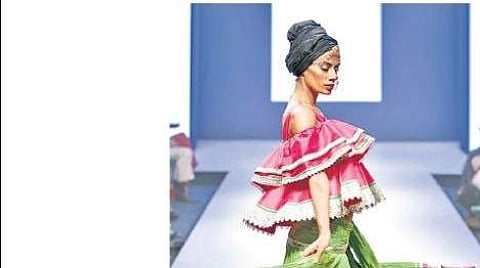
Today, Khadi has come a long way. It’s no longer the poor man’s cloth; it’s tailored into branded and designer clothes. Some of the top designers of the country are now using khadi in a big way.The legacy of khadi is what inspired many designers and drove them to do their bit for preserving the hand-woven craft. “For Gandhi, charkha was the tool with the support of which people could attain social, political, moral and economic development... That is the power of charkha. It requires no infrastructure, no formal qualification,” says fashion designer Ritu Beri.
“Today khadi had entered the lexicon of ‘Make in India’ and is a symbol of India’s potential economic self-sufficiency… I am honoured to get the opportunity to revive khadi as the Khadi and Village Industries Commission appointed me as the advisor for Khadi India,” says Beri.
The designer says she was inspired by Gandhiji’s words that swaraj in the absence of swadeshi would be a soulless body. “He said, ‘I am a salesman of swaraj. I am a devotee of khadi.’ I have vivid memories of my great grandfather spinning the threads on the instrument telling us interesting stories about the Mahatma’s khadi,” says Beri.
She says the point that khadi is environment-friendly — it has zero carbon footprint, requires no electricity or fuel to make it — has not been projected well. “It is also an ‘air conditioned’ material because in winters, it’s warm and in summers, it keeps you cool because it’s porous, handspun and hand-woven.”
Beri had a recent khadi couture collection designed to commemorate the 150th birth anniversary of Gandhi. “One of the greatest qualities of khadi that made it so popular was its existence as a social equaliser. Though it was meant for the masses and could be worn by the poor, it also caught the eye of the sophisticated,” the designer says. She, like Gandhiji, is “totally convinced” about khadi’s “invincibility”.
Divya Kumar, wardrobe artisan and co-founder of Earthistic Produce, feels the relevance of khadi is even more in the present socio-economic scenario where urban resources are under a lot of pressure. “Hand-woven heritage fabrics like khadi have always been espoused by designers. It’s only now that the designers working on the sustainability model — made relevant by validation from homegrown brands like Tata, Reliance, Aditya Birla etc. — has captured the imagination of the aspirational middle class,” she says.
However, Kumar says khadi is still largely a fabric for the ‘ideologue’ and is “not a fabric for mass consumption”. She says, “No fabric that caters to human avarice can be sustainable. Which is why we advice: buy less, use more and waste less. Which is why the Gandhian philosophy of simplicity, with a re-definition of basic, is still so relevant.”
Khadi’s heritage, simplicity and uniqueness are what attract fashion designer Raghavendra Rathore to it. “Khadi has always been synonymous with Indian heritage and its rich variety of hand-woven textiles. ...More than making khadi a showstopper material, the focus of its revival is to expand the khadi industry and engage more artisans through this process,” he says.
Rathore says khadi is “the most breathable” textile and its “rustic simplicity” makes it unique and special.With the present government promoting khadi in a big way, it’s gaining popularity among international designers, too. London-based designer Lars Andersson says, “Given a rise in awareness about sustainability in the fashion community, khadi is a natural choice, as it is very sustainably produced. The fabrics are alive... Each fabric is unique.”
“Coming from a knitting background, with all garments hand-loomed in my NYC studio, I cherish the craft of handmade… Spring 2018 was my first time working with khadi and handloom for my line. I loved it.”