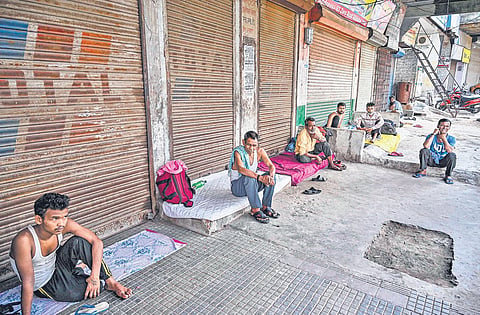

NEW DELHI: Aarti is in her sixties, who works as a cleaner in a restaurant in Ghaziabad and hails from Meerut. She works seven days a week to make around Rs 4000 a month of which she sends around 30 per cent home for her ailing husband. Similar is the story of Bhajan Singh, who hails from Bulandshahr and works as a rickshaw puller in Ghaziabad. He sends about 15 per cent of his monthly wage home to cater to his old parents. Aarti and Singh are among the approximately 5 crore migrant workers who send remittances home but have been unable to do so owing to lockdown.
This, according to experts, will have a major impact on the rural economy and will also lead to a mismatch of workforce. “There will be an oversupply of labour in rural areas and undersupply in urban areas for the next few months. Month of May will be particularly bad for both workers and firms due to this mismatch. From June, less so, because during the monsoon, migrant workers anyways spend time back home and many sectors like construction naturally slow down,” Professor at the (IIM-A) and an expert on migrant workers Chinmay Tumbe said.

According to figures estimated from the 2011 Census, a total of Rs 32400 crore worth of remittances are sent in India annually. Over 25000 crore of these contribute to the rural economy. Tumbe expects a huge hit to rural economies dependent on remittances. “This means economies particularly in eastern Uttar Pradesh, Bihar and coastal Odisha are likely to be hit greatly,” he said.
The IIM-A professor’s views were echoed by a field officer of SHRAM, a Delhi-based NGO involved in the welfare of migrant workers.
“People are talking extensively about the economy at large but there must be specific packages to help the rural economy recover. Apart from the contributions of agriculture, the economy runs majorly on remittances, which have drastically reduced due to the lockdown,” she said and added that one of the most common problems that the migrant workers have narrated to her involve their inability to send remittances.
Like many others, the only concern on Aarti’s mind is not being able to send money home.
“My husband is on the verge of being bed-ridden. I only have my daughter who is handicapped and cannot work. I am the sole bread earner in the family. What will my family do? My house is not even 100 km away but I can’t go nor can I send money,” she said. Tumbe suggests the rolling out of One Nation, One Ration card to deal with the looming crisis.
“Roll out the One Nation, One Ration card scheme immediately and provide portability of social security for migrant workers. Housing allowance should now be factored in the informal workforce just like it is done in the formal sector,” he said.