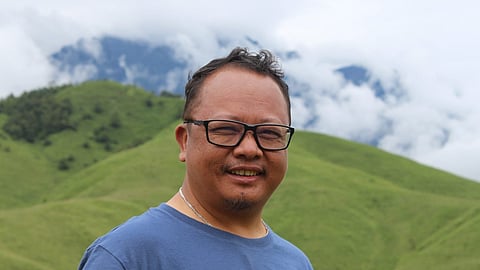

SIKKIM : From a butterfly chaser as a child, Nawang Gyatso Bhutia is now a renowned butterfly and moth conservationist. The 40-year-old has trained youngsters who now eke out a living as guides for butterfly enthusiasts and biodiversity researchers. His conservation efforts for the past 15 years have also led to the discovery and documentation of rare and endemic species, some previously unknown or undocumented in India.
Born in Sikkim’s historical town of Yuksom in the Gyalshing district, Bhutia became fascinated with the insect as a child, intently gazing at it as it fluttered in his garden.
Years later, in 2010, he began working for its conservation. However, it was tough collecting data as studies and resources were both limited. Soon, he came in contact with a dozen others, all of them butterfly conservationists. They formed an NGO, ‘Butterflies and Moths of Sikkim and Nature Conservation Society’, in 2011.
They worked across the state, spreading awareness about the conservation of butterflies. A ‘Northeast Butterfly Meet’ held in Assam in 2014 inspired them to organise their own. In 2015, their NGO held its first ‘Butterfly Meet of Sikkim’ in Yuksom in 2015. It drew 90 people from all over the country. School students were also involved.
The ‘Butterfly Man of Sikkim’, as the locals call Bhutia, recalls how they taught children about the lives of butterflies and how they work for their conservation. “The meeting helped us collect data on the butterflies found in Sikkim. It was the first step in conservation where we shared our knowledge with students. After touring Sikkim, we had a fair idea where to find which species,” says Bhutia, who considers Assam lepidopterist Monsoon Jyoti Gogoi his mentor.
Even as the conservation efforts continued, the NGO organised the fourth edition of the Northeast Butterfly Meet in Sikkim in 2017. Several youth were involved and provided with guide training.
“We have trained 200 young men and women so far. Around 50 of them now earn a livelihood as tourist guides. They were enlightened about the butterfly habitats,” Bhutia says.
These guides charge `1,000 to `1,500 per day from tourists who usually hire them for 3-4 days. Some of them are college and university students. A couple of guides are doing their PhD research. All of them are now members of the NGO and simultaneously work for the conservation of butterflies.

Many of them are from poor families. The NGO trains only those who have some knowledge about butterflies and are keen to work for their conservation.
The NGO members visit villages to spread awareness and coordinate with the state’s forest and tourism departments. They are invited by schools, colleges and universities where they give lectures on conservation.
“Of India’s around 1,500 butterfly species, 720 are found in Sikkim. You won’t find some of them elsewhere in the country. There are some that we find only at a particular time of the year. We have rediscovered six to seven species,” says Bhutia.
He is also part of a seven-member Facebook group called the ‘Northeastern Butterfly’. The members attend butterfly meets, wherever they are organised, as resource persons. They help conservationists in documenting butterflies and guide them to work for butterfly-based tourism and eco-tourism.
According to Bhutia, deforestation is a significant threat to butterflies. He says whenever the NGO receives a tip-off about individuals involved in tree chopping, it alerts the forest department.
“They act immediately. We have people monitoring illegal felling. We work together with the forest department. Sometimes, they fund our NGO members to carry out conservation activities,” Bhutia says.
He asserts their conservation efforts have not gone in vain, as evidenced by the rise in butterfly population. Such is the level of general awareness that even children do not harm butterflies now.
“Butterflies are one of the food chains for birds, lizards, etc. They help pollinate plants and flowers. If there is a plant, there is a butterfly,” says Bhutia, who views the discovery and documentation of some species as a success story of the NGO’s conservation efforts.
“More than just science, our initiative created ripples in society—sparking awareness, education, and pride in our natural heritage. One of the most tangible impacts has been the growth of butterfly tourism in Sikkim, which has provided income opportunities for local youth and homestays, especially in remote areas.” Bhutia says that by blending conservation with sustainable tourism, they have shown that protecting nature can also support livelihoods. He says he chose butterflies for conservation because they are not only beautiful and diverse but also sensitive indicators of a healthy ecosystem.
“Their presence or absence can tell us a lot about our environment. Although Sikkim has a large number of butterflies, mainstream conservation efforts often overlook them. By focusing on butterflies, I try to highlight their ecological importance and inspire people, especially youth, to appreciate the smaller, often unnoticed wonders of nature,” says Bhutia.
He intends to expand butterfly conservation zones, promote butterfly-friendly gardens in schools and eco-tourism sites, and publish more educational materials for communities. He also has plans to integrate conservation with sustainable tourism by encouraging butterfly tourism in Sikkim.
“I believe when people see value in protecting nature, they become its strongest guardians,” says Bhutia, who is in the Limca Book of Records for his work with butterflies.