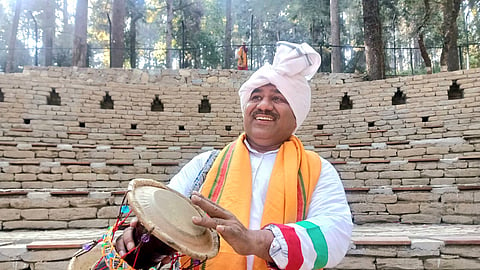

UTTARAKHAND : It is often said that a community’s language and culture are the most faithful mirrors of its richness and vitality. In the life of Shailendra Kumar Tiwari, an assistant teacher at Government Inter College, Tyuna Bagadwaldhar in Tehri, this truth finds its strongest expression. For nearly three decades, he has carried on a determined campaign to remind his people that the road to progress lies not in abandoning one’s roots but in embracing them with pride.
Tiwari completed his M.A. in English and could have sought opportunities in Dehradun or even Delhi, but he chose to return to his mountains. Born on August 5, 1974, to retired teacher B.R. Shastri and Yashoda Devi, his bond with Garhwal was formed early. The lure of cities never appealed to him. “The fragrance of the soil, the climate, the customs—these kept me here,” he says. His refusal to leave is also a protest against palaayan, migration, a word he utters with a trace of distaste. Since 1995, alongside his teaching duties, he has been working through theatre to keep Garhwali alive.
For Tiwari, the stage is a classroom where audiences can hear the cadences of their language, laugh at familiar idioms, and see their lives reflected at them. He credits Professor D.R. Purohit, a noted scholar of Uttarakhand’s folk culture, with awakening in him this passion for language and art.
Tiwari worries about the younger generation. He often points out that in Maharashtra, Gujarat, or Punjab, young people use their mother tongues with pride. Yet among Garhwali youth, he notices hesitation, even embarrassment, in speaking their dialect. Migration has made the problem worse. Families moving to the plains or outside the state raise children who grow up distant not only from their land but also from its songs, stories, and speech. To Tiwari, this disconnection is far more dangerous than the loss of population.

To illustrate the love Garhwalis once had for their land, Tiwari recounts a story from history. During the rule of King Medini Shah, when the king fell gravely ill, his wife, Queen Jia Rani, and son, Fateh Shah, took over. Fateh Shah, however, imposed arbitrary taxes and, on the advice of his courtiers, declared Sumadi village near Srinagar Garhwal as the new summer capital.
The order enraged the villagers, who rose in rebellion. Leading them was a 15-year-old boy, Panthya Dada. When the king ordered rebels to be thrown into a sacred fire pit, Panthya Dada chose to leap into it willingly, seeing it as
an act of honour. His aunt Bhadra followed him. Their sacrifice forced the monarchy to reverse its harsh decision. “Panthya Dada’s sacrifice,” Tiwari says reverently, “teaches us the power of staying connected to our roots.”
He believes that such stories must be told to today’s youth to keep their bond with their heritage alive.
At present, the Eighth Schedule of the Constitution lists 22 official languages. Despite being spoken by millions in Uttarakhand and beyond, Garhwali is not among them. “For Garhwali to be recognised, Parliament will have to pass an amendment act,” Tiwari explains. “It is not an easy process—it requires social unity, academic support, and political will.” He names Omprakash Semwal of Kalash Trust, folk singer Narendra Singh Negi, Shirish Dobhal, and Prof. Purohit among those who are part of this effort.