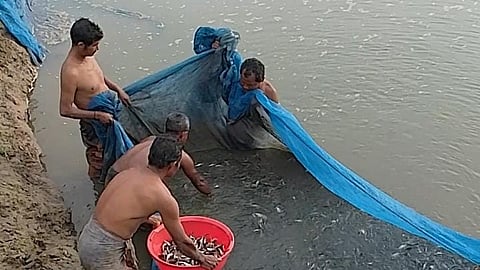

ASSAM : The Mishing tribe of Assam is known for its traditional knowledge of fishing, but some are innovative enough to yield results from a fusion of common sense and entrepreneurial skills.
Ten years ago, Girija Prasad Doley (47) from Dhemaji district dug his own land on borrowed funds to make a fish pond with just the ghost of a big idea at the back of his mind. It turned out to be one whale of a move. He bought 4,000 fingerlings and put them in the pond. He got 20 quintals of fish the next year.
He has not looked back since and has turned his 80 bighas of land (one bigha is 14,400 sq ft in Assam) into a sustainable integrated project, combining pisciculture, horticulture and agriculture.
Doley ploughed his field for paddy until 2015, when he conceived the idea of trying his luck in fish farming. He executed the plan in no time by digging about 4 bighas of his land to create a fish pond, using Rs 5 lakh borrowed from his friends.
He sold the 20-quintal fish he got the next year at Rs 3.6 lakh. He utilised a part of his profit in expanding his fish pond. He has been expanding it every year ever since then. It now stands at 26 bighas.
“The year 2015 was decisive in my life. I thought of launching a small-scale industry since land was not a problem, but it dawned on me that the industrial sector evolves over time. Fish came to my mind. Fish won’t disappear, and people will always eat it,” says Doley. His 26-bigha pond has five to six local fish varieties. He also has some smaller ponds where he rears other fish varieties.

In 2018-19, he started a hatchery with support from the district fisheries department under Assam’s Blue Revolution, which is part of India’s national “Neel Kranti Mission”, to transform fisheries by boosting production, modernising the sector with tech, ensuring food security, doubling fishers’ incomes, and empowering communities.
“My profit was less those days, as I was required to buy the fingerlings from faraway Nagaon and Barpeta. I discussed the matter with the district fisheries department, and it offered a 40% subsidy for a hatchery. I established it with two incubation tanks and one breeding pool. With time, my profit increased two-fold,” Doley says.
Procuring fingerlings from outside was costly due to transport expenses, but health losses were the bigger worry. Many died during long journeys, while survivors often took two to three months to recover.
The hatchery has eased this problem, allowing local farmers to buy healthier fingerlings at lower prices. Doley now sells five to eight lakh fingerlings annually at Rs 3–3.5 each.
His largest fish pond is engineered in such a way that the fish get transferred to his paddy fields during monsoon, and they return to the pond when the water in the paddy fields recedes.
“The benefit of fish-cum-paddy farming is that the fish get a vast area outside the pond for movement. They also get food and sunlight,” says Dr Gunjan Gogoi, senior scientist and head of Dhemaji Krishi Vigyan Kendra, which offers technical support to Doley. “The fish-cum-horticulture farming is giving him good yields of dragon fruits, which grow on the pond’s embankments,” Gogoi adds.
Doley rears cows, goats, ducks and chickens. He also has several fruit, sandalwood and “mahogany” trees. “These are my life insurance,” Doley says. He regularly visits villages across the district to motivate locals and raise awareness about farming. “We look for jobs, but we have them in our own houses. By and large, most of us in Assam have land, inherited from forefathers,” says Doley.
His aim is to expand his fish pond from 26 bighas to 100 bighas and develop agro-based tourism employing 50 to 100 people permanently.
“I lead a simple life. I neither own a car nor a bungalow. I have a small house on my farmland where I eat and sleep,” he says. His efforts have not escaped the government’s notice. “A farmer has transformed 26 bighas into thriving fish nurseries, producing lakhs of fish seeds and record harvests! With government support and his relentless hard work, Girija Prasad Doley truly embodies a self-reliant, resilient Assam, strengthening livelihoods right from the grassroots,” Chief Minister Himanta Biswa Sarma had posted on X.
Doley took it as the biggest compliment. “I am happy that the CM has appreciated my efforts. There cannot be anything bigger than this,” he says.
He has also expressed gratitude to Lakhinath Lagacung, an officer in the district fisheries department and Dr Lohit Baishya, head of Agronomy at the Indian Council of Agricultural Research, Dirpai, for their support in his journey.