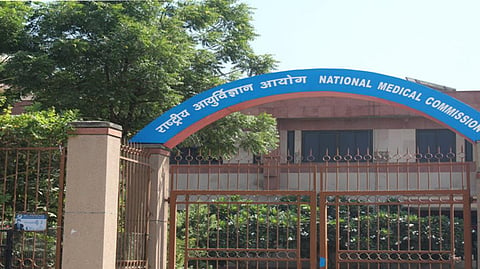

NEW DELHI: The National Medical Commission (NMC) announced on Saturday the interim guideline for admission in MBBS courses for students with disabilities and directed them to submit self-certified affidavits evaluating their functional abilities.
While the Unique Disability Identity Cards (UDID) have been established as a mandatory document for persons with disabilities, they must also report to the designated medical board – just 16 and not available in all the states - for verification of their self-certified affidavit.
The interim guidelines were announced as the NEET-UG counselling will begin on Monday.
the story two days ago that thousands of medical students with disabilities are in a dilemma as they are still awaiting the revised admission guidelines, as mandated by the Supreme Court in its various orders.
As per the interim guidelines, an aspirant with a locomotor disability and lower stability issues will have to give a self-attested affidavit about their functional ability, such as whether they can bear their weight and stand on their affected leg; walk on plain surfaces; sit in a chair on their own; climb stairs and turn right and left sides on their own.
In the same way, a NEET-UG candidate with locomotor disability with upper extremity coordinated activity will have to declare whether he can lift overhead objects and place them at the same place; can touch tip of the nose with the tip of a finger; can eat by himself; groom, comb by themselves; put on a upper garment on their own; clean after using the toilet; drink and hold glass; button and unbutton clothes; put on lower garments using the zip and hold a pen or pencil.
Dr Satendra Singh, a prominent disability activist, said, “Instead of moving forward, NMC has devised new mechanisms that once again shift the burden onto successful candidates with disabilities. These candidates are now forced to prove their competence not once, but twice - first through self-certification and then through assessments at one of only 16 designated medical boards.”
“This is in direct contradiction to the spirit of inclusivity envisioned by the Supreme Court,” said Dr Singh, the founder of Doctors with Disabilities: Agents of Change, the biggest pan-India group of health professionals with disabilities in India, striving for social justice.
“What was expected from the NMC was a comprehensive, forward-thinking policy on clinical accommodations, such as those implemented by regulatory bodies in the UK, and clear directives to medical colleges to establish Enabling Units, as already ordered by the Supreme Court. Yet, there is no mention of either in the interim guidelines,” he told this paper.
“The Supreme Court had reprimanded NMC for its ableism, yet the Commission has reintroduced it with appalling audacity - asking candidates if they can climb stairs unaided or demanding a 17-year-old aspirant submit an affidavit declaring they can follow and comprehend medical terminology,” said Dr Singh.
In a public notice, Dr. Raghav Langer, Secretary, NMC, said, “As per the Interim Guidelines, Persons with Benchmark Disability (PwBD) must submit a valid UDID issued by a designated medical authority under Ministry of Social Justice (MoSJE); self-certified affidavits; and the candidate will have to report to the designated medical board (16 designated medical boards) for verification of their self-certified affidavit.”
Also, these Boards will verify a candidate's self-certified affidavits and evaluate their functional abilities.
The previously mandated arithmetic threshold will no longer apply. Instead, emphasis will be placed on assessing a candidate's functional ability to meet the academic and clinical demands of the MBBS course.
On mandatory submission of a valid UDID, the notice said, “In this context, it may be regarded as an essential and authoritative proof for evaluating the eligibility of meritorious NEET-UG candidates under the disability category.”
The interim guidelines said that the NMC has undertaken proactive measures to ease challenges faced by PwBD candidates, ensuring a fair and inclusive medical education environment. This includes facilitating reasonable accommodations, revisiting eligibility norms, and adopting evaluation criteria focused on individual capabilities.
The guideline also said that Institutions must ensure that no student with a disability is denied admission on the grounds of disability; provided barrier-free access to buildings, classrooms, libraries, laboratories, hostels, and other facilities as per the standards notified by the Union Government.
Institutions were also advised to appoint a dedicated nodal officer or establish a disability cell to address the concerns and support needs of students with disabilities.
“An accessible and responsive grievance redressal system must be in place to address complaints related to discrimination or lack of accommodation,” it said.
The guideline highlighted extensive deliberations in various meetings of the NMC, in which a committee of medical experts was engaged. It said a consensus emerged to develop a comprehensive guideline focused on functional ability and reasonable accommodation to enable the fair inclusion of PwBD candidates in the MBBS program without subjecting them to undue hardship or exclusion.