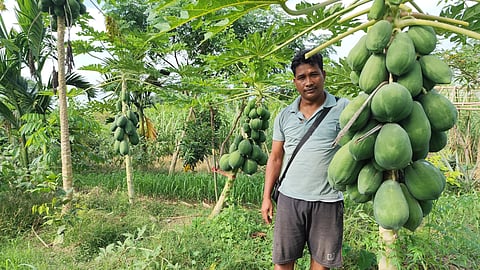

ASSAM : As a student, Dhoniram Chetia had seen villagers join an insurgent group and later, some of them “building a life” after surrendering. His family struggled to make ends meet, but the idea of enlisting in the outfit never crossed his mind. Instead, he chose to work as a daily wager before visualising a career in farming. Two decades down the line, he has earned a name for himself as a progressive farmer.
Born at Tekeri Gaon in the Pengeri area of eastern Assam’s insurgency-hit Tinsukia district, Chetia lost his father when he was six years old. His elder brother was eight then. Their mother worked in the fields, but the children had to chip in for the family to survive. Chetia plucked betel nuts, oranges, and sowed paddy saplings. His brother ploughed the fields of others.
Noticing their plight, the neighbours suggested they grow vegetables and papaya and sell them at the local market. Over time, Chetia developed an interest in farm work and the market attracted him. He started growing vegetables and planting fruit trees.
After Class 10, he moved to nearby Digboi for further education. He managed himself by working as a daily wager and briefly toiled as a labourer at the Digboi refinery. Some days he worked till 11 pm to earn extra money.
Midway through his graduation, he returned home in 2008 to become a farmer. The situation in the region those days was not good. Youths were under pressure to join the rebel group. Many faced police action for providing logistical support to the rebels.
“Security forces suspected every unmarried youth of helping the rebel group or having plans to join it. In order to avoid harassment, I got married soon after dropping out of college,” Chetia (38) says.
Some extremists from Tekeri Gaon would call up village youths to seek their help. As police and security forces tracked phone conversations, some feared reprisals and joined the outfit.
“If I had wanted, I could have also joined. I felt that a section joined the group to earn money after surrendering,” Chetia says.
A few young men, brutally beaten by security personnel on suspicion of aiding the rebels, began using opium to ease their pain. Slowly, the number of addicts grew — and with it, the reports of theft. Desperate for money, many turned to stealing to feed their addiction. In the midst of it all, Chetia took up work as a night watchman at a nearby tea estate.
In 2013, a sandbar on the Buridehing River caught his attention. In eastern Assam, such sandbars are familiar sights — they draw people for grazing cattle or fishing, but rarely for farming. Annual floods and a lack of knowledge about cultivation on these shifting tracts had long kept them barren.
The site lay about five kilometres from Chetia’s village. Locals avoided cultivating in the isolated area, fearing that any activity there might draw suspicion from both security forces and the rebel group.
“I cultivated the land and got a good harvest. Vast swathes of farmland by the verdant riverside lay unused, and I took a 4-bigha plot on lease from a villager. I cultivated king chilli and got a profit of around `2.5 lakh. With some of that money I bought that plot,” says Chetia.
Thereafter, he went on a buying spree, buying farmland from locals, one by one, after every harvest. Today, he owns 25 bighas, where he grows seasonal vegetables and fruits, including mango, banana, sugarcane, litchi, and others.
Chetia’s work doesn’t stop at farming—he actively shares his experiences and techniques on social media to inspire others.
