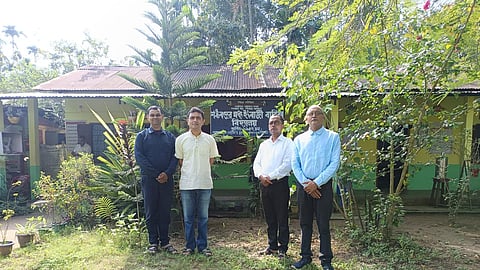

ASSAM : The Sankardev Girls’ Middle English School at Lahowal village in the Teok area of Assam’s Jorhat district had almost vanished from memory. Founded in 1952, it was once regarded by locals as a “heritage” institution, but over the years its classrooms emptied, its walls cracked, and its purpose faded. By 2017, the school had just one student left—against five teachers. The state government had already decided to merge it with a nearby institution, as part of its drive to close or consolidate schools with very low enrolment. Between 2018 and 2024, more than 8,000 elementary schools in Assam were either closed down or merged to ensure a standard teacher-pupil ratio, optimal use of staff, and reduced administrative costs. For Sankardev Girls’ School, the order seemed final.
Then came Gojen Phukan, a soft-spoken teacher who refused to give up. Phukan, 52, had joined the school as a teacher in 1999, when it already had only nine students. Nearly two decades later, when he was promoted to headmaster, the school was on the verge of being absorbed.
“The number of students at our school, which has classes from 6 to 8, kept falling each year,” he says. “I had just taken over as the headmaster when senior officials from the education department one day apprised me that the government had taken a decision to merge our school with another school due to low enrolment.”
For Phukan, who was born in the nearby Chintamonigarh village, about five kilometres away, the decision was deeply personal. He had long been connected with the people of the area through various socio-cultural and religious organisations.
“I outright protested the move on the grounds that I had newly taken it over as the headmaster and as such, it would be fair enough to give me some time to make an effort for improvement,” he recalls. “I assured the officials that I would not only work hard to increase enrolment but also improve the school’s performance.”
The officials decided to test his resolve. “They were impressed by my resolve, but threw down the gauntlet that I must take the number of students to ten by the next year. I accepted the challenge. The number of students rose to 12 within the deadline,” says Phukan. It didn’t stop there. Year after year, under his guidance, the school began recording fresh enrolments.
Today, it has 45 students, including 22 boys. Although it is a girls’ school, boys have been admitted throughout to ensure classes are full. The students now come from five villages in and around Lahowal. Phukan says a concerted effort made by teachers and the community helped revive the school. “I have a longstanding association with the community. I stand by the people during their good and bad days. I visit them when they are sick and try to help them however I can.
It is my nature. Slowly, people started embracing me, and a relationship was built,” he says. When he appealed to villagers to save the school, they responded by sending their children back. Earlier, most families preferred other nearby schools. “If a school lacks infrastructure even after receiving funds from the government for development, it cannot escape the watchful eyes of the public. We consider the public as our inspector.
A reason behind low enrolment in our school was that it remained disconnected from the community,” says Phukan. As numbers grew, so did expectations. The education department set a new goal — to achieve top ratings in Gunotsav, the Assam government’s flagship programme to assess and improve the quality of education. Under Gunotsav, schools are evaluated on students’ learning outcomes, infrastructure, cleanliness, community engagement, and attendance through both self-evaluation and external assessment.
“After the increase in students’ enrolment, the officials had set a new target for us – achieving an A+ in Gunotsav,” says Phukan. “We, all teachers and students, worked very hard. The result is there for everyone to see. We secured the A+ position in the subsequent six editions.” According to him, every aspect of the school is now monitored closely. “Everything— from students’ performance to school’s infrastructure, cleanliness, engagement with the community— is evaluated,” he says.