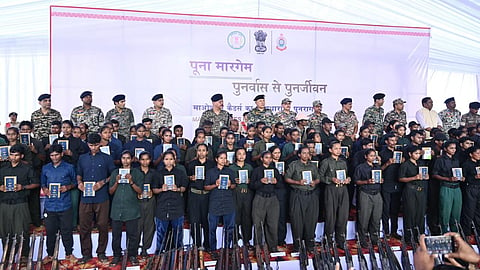

CHHATTISGARH : While countering guerrilla warfare across the hostile jungle terrain of Chhattisgarh, the Bastar Police’s preferred mode of operation lies in launching offensive measures. But, it knows that to win the prolonged battle, it needs to go beyond the vocabulary of warfare and win the heart and mind of surrendered Maoists, so that they are encouraged to lead a dignified life. This approach has gained momentum under the campaign “Poona Margham: From Rehabilitation to Reintegration”.
The state police apparatus attaches importance to this programme, which shows in its direct command being under an inspector general of police (IGP). Sundarraj Pattilingam, the Bastar range IGP, has already spent nine years in this war zone and has been given the task of closely supervising the initiative. “Poona Margham, meaning ‘the right path’ in the Gondi dialect, is more than just a rehabilitation programme for those joining the mainstream after renouncing the banned outfit: it is a movement of transformation,” he says. The Bastar range includes seven Maoist-affected districts of south Chhattisgarh.
The security forces are engaged in anti-Maoist campaigns in the area, keeping in mind the March 2026 deadline set by the Centre to end insurgency. The Poona Margham campaign is part of Mission 2026, with the aims of helping Maoist cadres abandon violence and reintegrate into society with dignity, safety, and purpose. It has the stated goal of bridging the gap between security operations and social inclusion.
The Poona Margham has become the cornerstone of this promising change and a key part of the larger rehabilitation policy for surrendered Maoists, something that has been acknowledged by CM Vishnu Deo Sai. “Under Mission 2026, the region has been witnessing a historic shift from confrontation to confidence... Those who surrendered will become ambassadors of peace, development, and trust in Bastar,” he said.

According to the Bastar IGP, the core objectives of the Poona Margham is firstly to motivate active Maoist cadres to renounce violence and embrace peace, followed by facilitating comprehensive rehabilitation, and to ensure community-based reintegration. “Every surrendered cadre under Poona Margham is not just a data point, it is a story of courage, change, and redemption,” says Pattilingam.
Over the past year, hundreds of Maoist cadres have surrendered under the initiative. The record surrender of 210 Maoists on October 17, 2025, including several senior leaders, in Jagdalpur marked a historic turning point. Most recently, 21 active Maoist cadres from the Kuyemari and Kiskodo Area Committees in Kanker district laid down arms under the Poona Margham, followed by the surrender of 51 Maoists in Bijapur. In last October, around 500 cadres have surrendered.
Under this programme, the police assess each surrendered individual and then rehabilitate and place them on a reintegration pathway to ensure long-term stability of the process. Community elders, social organisations, and district administrations play an active role in facilitating this social acceptance, making peace a shared community process.