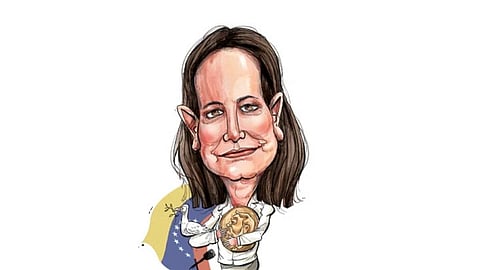

Of all the Nobel prizes, none has attracted as much controversy over the years as the peace prize—for both the choice of awardees and those not chosen. This year was no exception. The world recoiled and chortled in turns at the prospect of Donald Trump, who waged a global campaign to promote his candidacy, getting it. Perhaps someone should have told him that the nominations for 2025, which included 244 individuals and 94 organisations, closed 11 days after he was sworn in for the second time.
In the end, he who claimed to have stopped seven wars did not get it. But he made it a point to tell the world that the winner—María Corina Machado of Venezuela—called him to say, “I am accepting this in honour of you because you really deserved it.” In a way, Trump’s claim makes sense—Machado’s ambitions and policies have been closely aligned with US interests.
But first, let’s consider the wild swings of history that led up to this moment. In the only country that calls itself a ‘Bolivarian republic’ to honour Simón Bolívar, whose campaign led to the country’s independence from Spain in early 19th century, Machado is from a prominent royalist family. As the daughter of a rich steel magnate, she attended exclusive colleges in Venezuela and the US to train in industrial engineering and finance.
After running a charity for orphans, the then 37-year-old mother of three leapt into political prominence in 2004 when her vote-monitoring organisation, Súmate, called for unseating soldier-turned-president Hugo Chávez, a loud Bush baiter. She was indicted, among other things, for taking money from the US National Endowment for Democracy, allegedly a CIA front. The conservative Machado, a supporter of free markets, privatisation and fiscal austerity, has since been a darling of successive American regimes.
The support assumes significance while evaluating Machado’s career because Venezuela makes the US bristle at its perceived impertinence. The country in America’s backyard, which sits on the world’s largest oil reserves, nationalised its petroleum industry back in the 1970s. From 1999 onwards, it has been ruled by left-wing governments who have not held back punches while aiming volleys at the US political establishment. So when Trump said, “I’ve been helping her along the way,” he was putting his mouth where America’s money has already been.
What falls afoul of Alfred Nobel’s three criteria to award the peace prize— work for fraternity between nations, abolition or reduction of standing armies, and promotion of peace congresses—is Machado’s calls for foreign military intervention from the US and Israel for regime change at home. She has supported the US’s current blockade of her country and sinking of boats purportedly carrying drugs.
Another sharp contrast is visible in Machado’s elite status in a country ravaged by runaway inflation, where more than three-fourths of the 30 million citizens are estimated to be living in poverty. She has been called ‘Iron Lady’ not as a pun on her family business, but because she sees herself as Latin America’s Margaret Thatcher.
Yet, that the first Venezuelan Nobel laureate is a woman holds immense significance in a region marked by military rule and machismo. Over the last decade, a large number of Venezuelan women have moved to Brazil in search of work and better healthcare. At such a moment, the image of an assertive, unapologetic woman being feted around the world can be a beacon of hope.
Perhaps we should insist on ‘Nobelesse oblige’—a great responsibility that should befall someone endowed with a great honour like the Nobel. Peace efforts in Venezuela should include working to help the millions displaced and curbing gender-related violence that has risen in recent times. The Norwegian Nobel Committee’s choices have not necessarily goaded awardees away from violence in the past. We surely hope this won’t be such a case. Otherwise, the award’s stature would be diminished—again.
