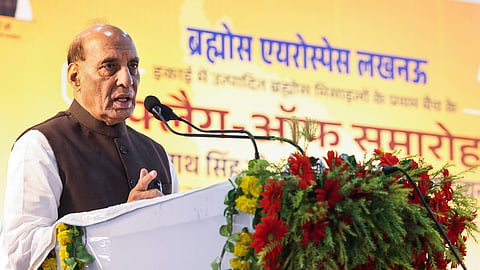

Defence Minister Rajnath Singh on Saturday asserted that "every inch of Pakistan's territory" lies within the range of the BrahMos missile, adding that what transpired during Operation Sindoor was "just a trailer."
Speaking after flagging off the first batch of BrahMos missiles manufactured at the new BrahMos Aerospace facility in Lucknow, Singh said the missile system had moved far beyond the trial stage and now stands as the strongest practical proof of India’s national security.
“BrahMos proved its effectiveness during Operation Sindoor. Victory has become our habit. What happened during that operation was just a trailer, and even that made Pakistan realise what India is capable of. If India could give birth to Pakistan, I need not say what else it can do,” the Defence Minister stated.
He described BrahMos as a key pillar of the armed forces and a symbol of India’s capability to turn its strategic ambitions into reality.
Singh also addressed challenges arising from disruptions in the global supply chain, especially spare parts, which he said were increasingly being used as "weapons" by supplier countries. “We are overcoming these challenges,” he affirmed.
The BrahMos Aerospace facility in Sarojini Nagar, Lucknow, which was inaugurated on May 11, is equipped with state-of-the-art infrastructure for missile integration, testing, and quality assurance. The first batch of missiles from this facility marks a significant milestone for the Uttar Pradesh Defence Industrial Corridor (UPDIC) and India’s push for self-reliance in defence manufacturing.
“This facility will manufacture around 100 missiles every year, supplying them to the Army, Navy, and Air Force,” Singh said. “Built on approximately 200 acres at a cost of about Rs 380 crore, it will also generate employment for hundreds of people.”
Rajnath Singh revealed that the BrahMos team had signed contracts worth approximately Rs 4,000 crore with two countries in the past month. He noted that, in the coming years, experts from around the world would visit Lucknow, transforming the city into a hub of knowledge and leadership in defence technology.
“The turnover of the Lucknow unit is expected to reach Rs 3,000 crore from the next financial year, with GST collections around Rs 500 crore,” he added.
Rajnath Singh emphasised that India is now at a stage where it is not only strengthening its national security but also proving to the world that it is a credible partner in defence and technology.
He highlighted that achievements like the BrahMos missile system have shown that "Made in India" is no longer just a slogan but a globally recognised brand. “Whether it's the export of BrahMos to the Philippines or future cooperation with other countries, India is now playing the role of a giver, not just a taker. This is the true essence of Aatmanirbhar Bharat—the vision with which the Modi government began its journey in 2014,” Singh said.
He added that Prime Minister Narendra Modi has envisioned an India that is fully developed, self-reliant, and ready to lead the world by 2047, with the defence sector playing a decisive role in achieving that goal.
Further, Rajnath Singh called for a clear project roadmap to integrate small entrepreneurs into the defence ecosystem.
“The Uttar Pradesh Defence Industrial Corridor will only achieve full success when small industries grow alongside large companies,” he said. “I am confident that UP will not only become a manufacturing hub in the future but also emerge as a new epicentre of innovation and employment for entrepreneurs—both small and large.”
Uttar Pradesh Chief Minister Yogi Adityanath, in his address, described BrahMos as a missile of Aatmanirbharta (self-reliance), fulfilling the nation’s defence needs.
He expressed gratitude to Prime Minister Narendra Modi and Defence Minister Rajnath Singh for enabling Lucknow to play a central role in India’s journey towards self-reliance in defence manufacturing.
Yogi Adityanath said the missiles produced in Lucknow represent an assurance of safety and prosperity for the people of India. He also highlighted progress across all six nodes of the UP Defence Industrial Corridor, noting that over 15,000 youth had gained employment through the initiative.
(With inputs from TNIE Online Desk)
