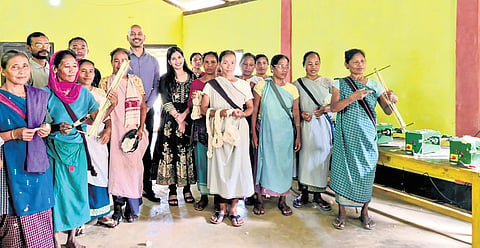

MEGHALAYA: From teaching children stories to spinning silk, Meghalaya’s Konica Maiong has found a new path that has transformed her life.
A year ago, the 36-year-old teacher was juggling two modest incomes—around Rs 4,000 a month from selling Eri silk cocoon and yarn, and another Rs 4,000 from teaching at a local private school. Thanks to an initiative by the Ri-Bhoi district administration, her earnings have quadrupled, and she no longer needs to teach.
“I struggled a lot earlier when I produced cocoon by following the traditional hand-spinning method. My income was less because my production was less. Now, I earn about Rs 12,000-Rs 15,000 a month. I have quit the teacher’s job following this steady income,” Konica says.
Ri-Bhoi district has a long tradition of Eri silk farming. However, most farmers stop at producing cocoons and sell them to neighbouring Assam, missing out on the higher profits that come from converting cocoons into yarn. Recognising this, the district administration took an innovative step: it set up 30 Eri Silk Spinning Centres across 30 villages to support local farmers.
These centres, equipped with more than 250 spinning machines, offer farmers the opportunity to process cocoon into yarn efficiently. At Konica’s village of Diwon, the local spinning centre has 16 machines. Located outside the building of a local organisation, the centre sees 20 to 40 Eri farmers arriving every day.
District Magistrate Abhilash Baranwal, who was posted to Ri-Bhoi last year and launched the initiative, says, “Until then, the farmers relied on the traditional drop spindle (Takli)-based spinning methods. Production was very low—about 20 grams of yarn after an effort of eight hours. The machines have now multiplied yarn production. Cocoon is sold at Rs 700-Rs 800 a kg while yarn fetches Rs 2,600 to Rs 4,000 a kg depending upon quality.”

The “Ribhoi Threads” mission, launched last year, aims to increase the income of sericulture farmers while meeting the growing demand for non-violent silk. The rising awareness of eco-friendly products has created a market for Eri silk, which is harvested without killing the silkworms.
Each spinning centre is equipped with eight to 13 solar-powered spinning machines, depending on the size of the local farming population. These machines are 12 times more efficient than traditional methods. Village organisations, which are federations of self-help groups, were entrusted with managing the centres. Their role includes encouraging women to use the centres and creating a sense of collective ownership.
Moving forward, the village organisations plan to charge a nominal fee from spinners to ensure the centres are self-sustaining. In the first phase, 1,500 women were trained, with another 1,500 set to be trained in the second phase. Every village has a master trainer who teaches all women Eri farmers, and a technician per block has been trained to handle minor repairs.
Cluster resource persons help with administration, including documentation, attendance monitoring, mobilising farmers, and arranging cocoon when needed. Additionally, the social enterprise Resham Sutra has developed an app to track the spinners’ skills and monitor yarn production at the farmer level. Each centre also has weighing and quality check machines to encourage spinners to improve their output.
Teibor Khongsni, District Mission Manager, Meghalaya State Rural Livelihoods Society, says Ri-Bhoi has been always rich in Eri Silk but lacked technology, and to promote livelihood in the areas, the DM arranged for the spinning machines which have helped increase production.“The villagers are now planning to upscale Eri rearing. During my visits to villages, they told me that the machines are helping them a lot. The impact has been encouraging. People are coming in batches. Some new households have also shown an interest. It is a positive development for Ri-Bhoi,” Khongsni further says.