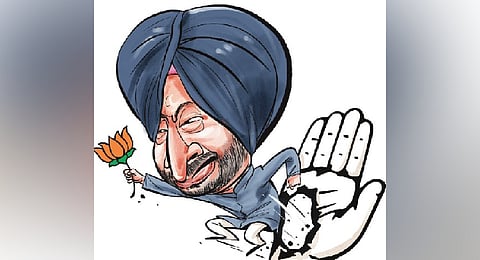

In the charged forecourt of Parliament, amid slogans and symbolism, a brief exchange revealed a deeper political fracture this week.
As Congress MPs celebrated nearby, Ravneet Singh Bittu, now a BJP minister, remarked wryly that it seemed as if they had “returned after winning a war.”
Rahul Gandhi, spotting him, responded with a smile: “Hello, brother! My traitor friend. Don’t worry, you’ll come back.” The remark was casual, almost teasing, but it marked a rupture years in the making.
Once among Gandhi’s protégés in Punjab, Bittu now stands firmly on the opposite side of the aisle, his journey emblematic of the churn, ambition and sharp rhetoric that defines contemporary Indian politics.
At 50, Bittu carries a formidable political legacy. He is the grandson of former Punjab Chief Minister Beant Singh, assassinated by Khalistanis in 1995. That legacy long anchored him within the Congress, a party his family had served for decades.
Today, as Union MoS for Railways and Food Processing Industries in the BJP-led government, he embodies a rare but consequential political crossing. Bittu hails from Kotla Afghana village in Ludhiana. His early life was shaped by personal loss, his father died when he was 11, and his grandfather was assassinated when he was 20. Politics was not his initial pursuit. A Class XII pass-out, he once ran a small cement factory, seemingly distant from public life.
That changed in 2007 when he met Gandhi, then newly appointed general secretary of Youth Congress. Gandhi reportedly urged him not to squander his grandfather’s legacy and to enter politics. Within a year, Bittu was appointed president of the Punjab Youth Congress at 33, a rapid rise that reflected Gandhi’s faith in him.
In 2009, Bittu was elected to the Lok Sabha from Anandpur Sahib on a Congress ticket. He later shifted to Ludhiana, winning parliamentary elections there in 2014 and again in 2019. In 2020, he was appointed Congress whip in the Lok Sabha, cementing his status as a party insider and trusted lieutenant of the Gandhi leadership.
His career, however, was not without setbacks. In the 2017 Punjab Assembly elections, Bittu contested from Jalalabad against Shiromani Akali Dal president Sukhbir Singh Badal and AAP leader Bhagwant Mann. He finished third, a reminder that lineage alone does not guarantee electoral success. Still, he maintained cordial relations across party lines, including with Bhagwant Mann, now Punjab’s Chief Minister.
The decisive break came ahead of the 2024 general elections, when Bittu quit the Congress and joined the BJP. The move shocked Punjab’s Congress leadership, which viewed him as both heir and symbol. Contesting from Ludhiana on a BJP ticket, Bittu lost to Punjab Congress president Amrinder Singh Raja Warring by over 20,000 votes. Despite the defeat, the BJP stood firmly by him. Bittu was nominated to the Rajya Sabha from Rajasthan and inducted into the Modi cabinet, signaling the party’s confidence in the strategic value in Punjab.
The campaign itself was bruising. A day before filing his nomination, the Ludhiana civic body accused him of illegally occupying a government house for eight years. He was forced to vacate and pay `1.82 crore as penalty. That night, he reportedly slept on the floor of the BJP office, a scene that quickly entered campaign folklore. Congress leaders also attacked him for using Beant Singh’s image on BJP posters. Bittu defended himself fiercely, insisting that his grandfather’s legacy was personal, not partisan. He even revived Beant Singh’s old white Ambassador, calling it his “lucky charm,” to file his nomination.
A vocal critic of pro-Khalistani elements, Bittu frequently describes himself as a nationalist and has claimed to have received threats in the past. From the Congress loyalist to the BJP minister, Bittu’s journey reflects the volatility of Indian politics, where allegiance is fluid and legacy constantly renegotiated.
