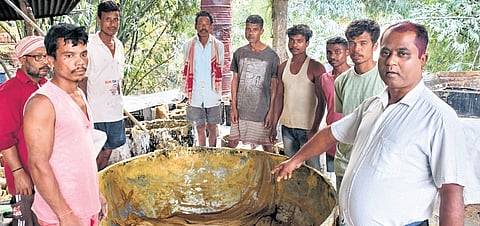

Romen Das seems to have the Midas touch. Whatever business he lays his hands on appears to prosper. But behind the success story is a childhood marked by poverty, hard labour and tough choices, including putting business ahead of formal education to support his struggling family.
Born in Tipomia Shantipur village in Assam’s Jorhat district, Das, now 48, grew up in difficult circumstances. His father, an illiterate man displaced by floods from Nimati Ghat, earned a living by selling vegetables and occasionally ploughing other people’s fields. Despite severe financial hardship, he strongly believed in education and ensured that all six of his children—Das and his five sisters—attended school.
The family lived on a government-allotted plot along with several other flood-displaced families. Life was never easy. Watching his father struggle day after day left a deep impression on young Romen.
“He worked very hard and for a long time. Watching him struggle, I made up my mind as a child that I would not go for higher education and instead, help him by doing something,” recalls Das.
His first brush with business came early. At just eight years old, he began selling leafy vegetables in village markets. By the time he was in Class 3, he had become a regular trader. “I was in Class 3 when I started selling fresh coriander, grown on our land. My father sold vegetables and later took to the fish trade. He would give the fish that he could not sell to me, and I would sell it off in the village markets,” says Das.
As he grew older, he juggled school with odd jobs. When his father started trading in goats, Das was given the responsibility of collecting payments. He would cycle 15 kms, everyday.

While still in high school, Das developed a fascination for audio cassettes. That interest led him to enrol in the electronics branch of the Industrial Training Institute (ITI) in Jorhat. To arrange the fees, his father sold a cow for Rs 4,000. It was during his ITI days that Das learnt another important lesson—how to save money. He would save around Rs 50 every week from the money his father gave him for food and studies. He even opened a bank account.
After completing ITI, he returned home and took a loan of Rs 12,000—not from PNB, but from a rural bank. With that money, he opened an electronics shop that sold and repaired audio cassettes, radios, tape recorders, and televisions. As savings grew, he opened a second shop in a nearby village. Business was good, but Das sensed change coming.
Looking for new opportunities, he turned his attention to transportation. A family he had known for years helped him raise Rs 80,000 by mortgaging a life insurance policy.
“I bought a mini truck; that money is a down payment,” says Das. “I started a business in vegetables and used the vehicle to transport them. When I was free, I repaired electronic items.”
That was the turning point. One vehicle led to another. Today, Das owns 17 buses and mini trucks. His business interests now include a soap-manufacturing unit, a rice mill, a poultry feed mill and paddy husk trading for biofuel. His poultry farm alone houses 12,000 chickens. His enterprises employ around 60 people.