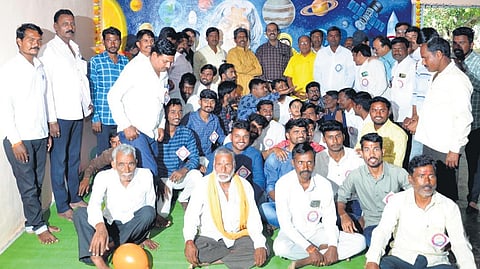

Breaking the regressive caste walls that stood firm and shamed humanity for ages was something Nanasaheb Gangabai Anandrao Kadam aspired to since childhood.
Kadam, who started his career as an assistant registrar of a co-operative society with the Maharashtra government, leads a comfortable life otherwise but has always wanted to do something different for the people of his village, Ranjara, in the Hingoli district of Maharashtra.
To give directions to his aspirations, Kadam, along with his college friends—all government employees—used the concept of ‘human mind psychology’ as a tool to break the caste walls.
An officer on special duty to BJP minister Atul Save, who handles the Other Backward Class (OBC) welfare ministry, Kadam says, “Since childhood, I was fascinated with the social reforms brought in by Mahatma Phule, Rajshri Shahu Maharaj, and Dr B R Ambedkar. These reformers made lives of several communities that were treated no less than animals meaningful. They strove to break the dogmatic mindset of the people and asked each one to educate their children. It was a life mission to them, and they walked over this hurdle-ridden path,” Kadam said.
To drive home the message of unity, they started with painting the village wall with powerful social messages. “For example, a ‘scientific wall’ at Hanuman Temple was a unique project. The reason -- without a scientific temperament, there would not be real development. Children and adults, while visiting the temple, would read science-related information and observe the pictures. It was routine for many of them, which led to children developing interest in science. It ignited their curious minds,” Kadam said.

In several places, the housing colonies or community places are named after some or other leaders and religious persons. “We introduced a different concept that the housing colonies will not be named in the traditional way. We live in the 21st century, and our housing societies and colonies are named after the caste and communities, which is quite bizarre. Then, we started naming these colonies after principles of humanity like equality, fraternity and liberty. We asked the children to come and pick the chit where such universal human values are based and started naming the colonies after these universal names, such as Brotherhood Colony, Affection Colony, and Blissful Colony.”
These new names were accepted by every caste and creed. Otherwise, each leader and big figure name was opposed for some other reason. But these new names helped to maintain the peace and avoid the controversy as well. So, we tried to build peace in a different way in society by changing their psychology, Kadam said.
He said that they also started the library and asked children to spend more time in the library by reading various books and even asked them to share their feedback about the book they read.
“We also arrange the speeches of social thinkers so that the people of the village get knowledge of what is happening around the world. We wanted to build a bridge between spirituality and science. I myself come from the long and rich tradition of the Bakti movement that accommodates each caste and creed without any hesitation,” Kadam said.
He added, “We were focused on inclusive and cohesive development of human beings. We initially dropped the pamphlet of our plan and intention at every household of our village, Ranjala, in Hingoli district. And, I asked them to assemble at a specific place at a specific time. We were ready with all the material and answers.
But surprisingly, hardly anyone turned to support our concept. People easily assemble for religious and political activities, but there was a lukewarm response to human mind development. Many people ignored us. But we did not get discouraged and decided to work in different way,” Kadam said.
He said that they started arranging the workshop during the festivals and asked the people to participate. “Then slowly, the people’s interest developed. Then, we celebrated the Bali Raja Jayanti – Bali Raja – the farmers’ king in whose kingdom farmers were very happy and prosperous,” Kadam added.
Therefore, even today, in rural areas, farmers’ spouses during Diwali sing the song that invites the second Bali Raja to rule over this earth so that the poverty-and debt-ridden farmers will get relief. On this occasion, they shared the different stories of Bali Raja and asked them to share their stories. It was a very good interactive session,” Kadam said.
Kadam said that he earlier worked as a primary school teacher in a government school, so he has learnt two key skills in teaching: to keep it simple and to keep patience, because you are teaching children. “We want to focus on progressive thinking. We are also asking the people to keep their area clean, and urging each household to plant one tree in front of their houses and water them with the water from cleaning. Our next target is to build a good school for our children,” Kadam added.