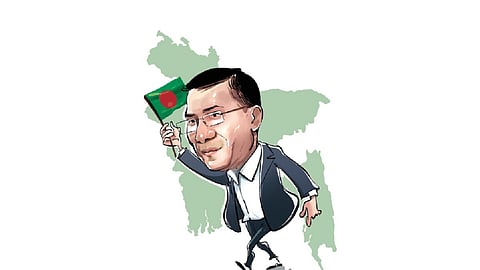

When Tarique Rahman removed his shoes and placed his feet on the ground beside a Dhaka car park on December 25, the gesture carried the weight of unfinished history. After 17 years in exile, it was a homecoming expressed less through slogans than restraint, a politician reconnecting with a country that had moved on in his absence. Five days later, the death of his mother, former Prime Minister Khaleda Zia, gave the moment institutional finality. It sealed the transfer of political inheritance and opened a new chapter in the intricate terrain of Bangladesh’s politics.
Born on 20 November 1965, Tarique Rahman is the son of two of the most consequential figures in Bangladesh’s history—the late President Ziaur Rahman, a decorated freedom fighter and military ruler-turned-politician and former Prime Minister, the late Khaleda Zia, the enduring matriarch of the BNP.
Politics was never distant for him. Yet Rahman’s trajectory has been shaped as much by rupture as by inheritance— by exile, repression, and the long shadow of unfinished transitions in Bangladeshi democracy.
Educated at Dhaka’s BAF Shaheen College and later at the University of Dhaka, where he studied International Relations, Rahman came of age intellectually amid the collapse of General Ershad’s autocratic regime. He immersed himself in political philosophy, from Aristotle to Rousseau, Marx to Locke, and graduated during a period of mass mobilisation led by his mother. Those years might have helped him forged a worldview attentive to the mechanics of power and the fragility of institutions.
Before fully entering party politics, Rahman established himself as an entrepreneur, building businesses in textiles and agro-based industries.
That experience would later inform his emphasis on economic liberalisation and private-sector growth. He formally joined the party in 1988, working at the grassroots during the anti-Ershad movement and campaigning nationwide ahead of the landmark 1991 election that returned Bangladesh to parliamentary democracy and made Khaleda Zia the country’s first female Prime Minister.
Rahman’s early political reputation rested less on office-holding than on organisation. In Bogura, he pioneered internal party elections by secret ballot, pushing democratic practices downward into local structures. After the BNP’s landslide victory in 2001, he resisted pressure to assume government office, instead focusing on policy research, civil society engagement, and party-building.
Appointed Senior Joint Secretary in 2002 and later Senior Vice-Chairman, he became central to the BNP’s nationwide mobilization. That ascent was abruptly halted in 2007, when an army-backed caretaker regime launched a sweeping crackdown. Rahman was arrested, subjected to severe mistreatment in detention, and ultimately forced into exile in London for medical treatment. From there, he watched as Bangladeshi politics hardened into an increasingly authoritarian order under Sheikh Hasina, with the BNP marginalised, its leaders jailed, and its legitimacy relentlessly questioned.
Yet exile did not mean withdrawal. Elected Senior Vice-Chairman in 2009 and appointed Acting Chairman in 2018 after Khaleda Zia’s imprisonment, Rahman became the party’s strategic fulcrum from abroad. He articulated a narrative that challenged accusations of extremism and disloyalty, reasserting the BNP’s historical links to the 1971 Liberation War and its foundational commitment to parliamentary democracy. Like Sheikh Hasina’s invocation of her father’s legacy, Rahman has drawn on his own.
Rahman’s return to Bangladesh comes at a moment of profound uncertainty. After 17 years in exile, he has stepped back into a landscape reshaped by the collapse of the previous government in 2024, the installation of an interim administration under Nobel laureate Muhammad Yunus, and the death of his mother, Khaleda Zia.
Addressing a vast Dhaka crowd for the first time since 2008, Rahman struck a measured, inclusive tone, calling for inter-communal harmony, a “safe Bangladesh” for all citizens, and the repayment of the “blood debt” of martyrs from both 1971 and the recent uprising. “I have a plan for Bangladesh,” he declared-framing ambition through governance, not grievance. On foreign policy, he has avoided performative hostility, echoing his father’s guarded cooperation and regional multilateralism. At home, he seeks to institutionalise the BNP, transforming it from a personality-driven movement into a policy-oriented party ready to govern a diverse, youthful, and aspirational nation.
Whether that ambition can be realised remains the central question. As the front-runner in an impending general election, Tarique Rahman faces the dual challenge of honouring a formidable legacy while redefining it. If he succeeds, his barefoot step onto Bangladeshi soil may be remembered not merely as a symbolic return, but as the opening move in a broader effort to stabilise and reimagine his country’s democratic future.
