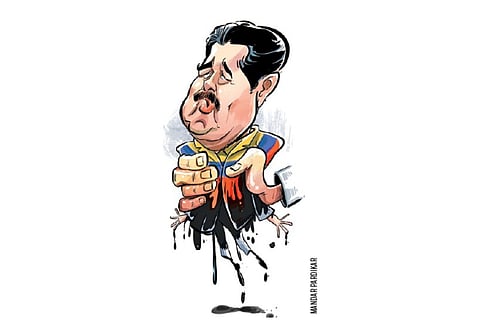

Nicolas Maduro Moros’s story has always unfolded at the seam between belief and brute force, between the intimacy of loyalty and the cold mechanics of power.
It ended in the early hours of a January morning, when US soldiers dragged him and his wife, Cilia Flores, from their bedroom and flew them out of Venezuela.
For a man who spent more than a decade insisting that Washington was plotting to kidnap him, the final image was cruelly symmetrical.
Maduro was never meant to be Hugo Chavez. He lacked the thunderous charisma, the improvisational brilliance, above all the soldier’s authority. Tall, mustachioed, with a habit of misspeaking in English, he might have seemed an improbable heir to a revolution built on spectacle. Yet that improbability became his defining political skill. Where Chavez dazzled, Maduro endured.
Born in 1962 in the working-class neighbuorhood of Caracas, the son of a trade unionist steeped in old-party politics, Maduro entered public life not through barracks or universities but on a bus route, as a driver for the Caracas Metro.
Union activities carried him upward. Ideology certainly followed through the Socialist League, student politics, a taste for John Lennon lyrics and anti-imperialist rhetoric. Power followed loyalty. Chavez took note of it all very early.
By the time Chavez’s illness hollowed out the Bolivarian state, Maduro had positioned himself as indispensable, speaker of the National Assembly, then foreign minister, then vice president. In December 2012, with death closing in, Chavez ended internal rivalries by anointing him successor. The blessing mattered. It gave Maduro legitimacy he would never relinquish.
Maduro’s first victory in April 2013, by fewer than two percentage points, set the tone for what followed. The opposition questioned the result and took to the streets. The government responded with a mix of concessions, institutional closure, and force. Through elections in 2014, 2017, 2019, and 2024, this dynamic hardened into a system of its own.
Yet Maduro was not simply a caricature of authoritarianism. His personality, stubborn and literal, shaped his rule. A Catholic by birth, he and Flores became devoted followers of the Sathya Sai Baba, whose portrait once hung in his private office alongside Simón Bolívar and Chávez. When Sai Baba died in 2011, Maduro declared a national day of mourning. He spoke of light, destiny, and spiritual warfare with the same cadence he used to denounce sanctions and coups. To supporters, it signaled sincerity. To critics, nothing but delusion.
The world Maduro inherited slowly crumbled around him. Oil, the lifeblood of Venezuela, fell victim to mismanagement, corruption, global price declines and designs of outside powers. Maduro blamed the United States, and not without cause though not without exaggeration.
Washington’s pressure spanned administrations and tactics—from personal sanctions and oil restrictions to rewards for arrest, sporadic dialogue, and, eventually, military force. The toughest oil sanctions came only in 2019, after Venezuela’s economic collapse was already underway, but they compounded the damage and narrowed Maduro’s options. Each escalation also gave him political cover, reinforcing his narrative of sovereignty under siege.
Still, survival required more than political valour. Maduro mastered the art of dividing enemies and buying time. He neutralized an opposition victory in parliament in 2015. He convened a constituent assembly in 2017 to sideline hostile institutions. He talked endlessly, dialogue as a delaying tactic, while consolidating control. He leaned on the military and cultivated armed civilian groups. The US prosecutors would later allege that Maduro led the Cartel of the Suns, a narco-terror network entwined with Colombia’s FARC. Maduro denied it all.
International isolation never fully broke him. Russia, China, Iran, and Cuba offered lifelines. Even as leftist allies like Brazil and Colombia recoiled from his 2024 election claims, Maduro clung on. He was sworn in again in January 2025, defiant, a man convinced that history rewarded those who refused to blink. It was all good as long as it lasted.
In the end, the decisive blink came from outside in the form of a US intervention, carried out without a United Nations mandate and without explicit authorisation from the Congress, that finally removed him. He was neither a mere puppet of circumstance nor an omnipotent tyrant in full command of events. He was a believer who learned, gradually, to govern through means he found ideal, a man who spoke of God, destiny, and light while ruling a country sunk in shadow.
