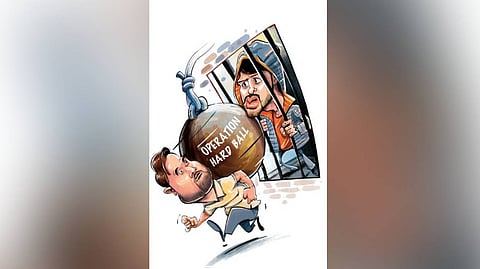

A decade ago, Lawrence Bishnoi and Satwinderjit Singh alias Goldy Brar were names largely associated with student politics and local gang wars in Punjab. Today, they are at the centre of one of India’s most closely watched organised crime investigations, with their alleged networks stretching across continents.
The two Punjab-born gang leaders have become symbols of a new generation of criminal syndicates that operate beyond geographical boundaries, combining traditional structures with overseas networks, digital communication and financial channels. The US has now indicted Bishnoi and Brar under the Racketeer Influenced and Corrupt Organizations (RICO) Act, accusing them of involvement in targeted killings, extortion, drug trafficking and other crimes.
The action follows investigations by US agencies into Indian crime syndicates under Operation Hard Ball, highlighting how gang wars in Punjab have evolved into international organised crime operations. Among the cases under scrutiny is the 2023 killing of Canadian citizen and pro-Khalistan activist who was designated as a terrorist by India, Hardeep Singh Nijjar, with Bishnoi and Brar named in connection with allegations surrounding the murder.
For investigators, the rise of the duo reflects the transformation of Punjab’s gang culture, from street-level rivalries to sophisticated networks with links across Canada, the US, Europe, Australia and other countries.
Born in 1993 in Dutaranwali village of Fazilka district, Bishnoi’s journey into organised crime began in the corridors of student politics in Chandigarh. A student of DAV College and associated with Panjab University’s political circles, he initially gained attention through campus rivalries.
His association with student leader Vicky Middukhera proved significant in shaping his early years. Police records indicate that Bishnoi’s first criminal case was registered in 2010 following a clash involving student groups. Subsequent encounters with criminals during prison terms became a turning point, helping him develop contacts in the world of arms and organised crime.
Over time, Bishnoi built what investigators describe as one of India’s largest criminal syndicates, with hundreds of aides spread across Punjab, Haryana, Rajasthan, Delhi and Maharashtra, as well as overseas locations. The NIA, in its 2023 chargesheet against Bishnoi, alleged that his gang had developed links with foreign-based associates and used proceeds from extortion activities to support operations abroad. The agency claimed that money generated through criminal activities was routed to Canada, the US, the UAE, Thailand and Australia.
Bishnoi’s name has been linked to several high-profile cases, including Punjabi singer Sidhu Moosewala in 2022. He has also been accused in connection with the murder of Maharashtra politician Baba Siddique in 2024. Beyond these cases, Bishnoi gained national attention after repeatedly threatening Bollywood actor Salman Khan, citing the actor’s involvement in the 1998 blackbuck poaching case.
Currently lodged in Gujarat’s Sabarmati jail, Bishnoi’s name has become a brand of fear and influence within India’s underworld.
While Bishnoi became the public face of the gang in India, Goldy Brar emerged as the overseas link who allegedly helped expand its operations internationally. Born Satwinderjit Singh in Muktsar, Brar first came into contact with Bishnoi during their college years.
The two reportedly shared a close friendship, addressing each other as “bhai”, before their relationship evolved into a criminal partnership. Brar moved to Canada in 2017 on a student visa and is alleged by Indian agencies to have coordinated gang activities from abroad.
He is among India’s most wanted fugitives, facing cases linked to the killing of Moosewala and the murder of Youth Congress leader Gurlal Singh Pehalwan.
A Red Corner Notice was issued against him in 2022, and US authorities have announced a reward for information leading to his arrest.
The alliance between Bishnoi and Brar has reportedly weakened in recent years. Differences over internal issues and handling of cases involving Bishnoi’s younger brother Anmol are believed to have triggered a split.
