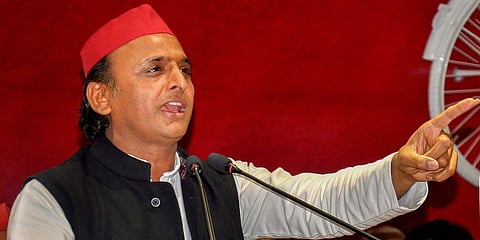

The bypolls for nine Assembly seats in Uttar Pradesh on November 13 have become a tug of war between CM Yogi Adityanath and Samajwadi Party (SP) president Akhilesh Yadav. Akhilesh wants to replicate his success in the 2024 Lok Sabha elections through his PDA (pichda, dalit, alpsankhyak) social engineering. He is optimistic because the SP vote share jumped from 17.96% in 2019 to 33.59% in 2024, with the party winning 37 Lok Sabha seats. In the assembly elections earlier in 2022, his party polled 32.06% votes. Can this be credited to the PDA experiment? Will this also work in the byelections and beyond?
Akhilesh became SP president on January 1, 2017. Since then, he has been experimenting with social engineering and coalitional politics. The PDA is his latest bid at social engineering. Earlier, former PM Charan Singh formed AJGAR (Ahir-Jat-Gujjar-Rajput) in 1960s, later adding ‘M’ to make it MAJGAR (Muslim, Ahir/Yadav, Jat, Gujjar, Rajput). Akhilesh's father Mulayam Singh Yadav used the ‘MY’ (Muslim-Yadav) combination while Akhilesh tried GAJAB (Gujjar-Ahir-Jat-Brahmin) in 2022. But the PDA worked best.
Akhilesh also experimented with ‘UP-ke-do-ladke’ in 2017 when he tied up with Rahul Gandhi of the Congress for the Assembly polls without success. In the 2019 Lok Sabha elections, he joined hands with arch rival and BSP supremo Mayawati, hyped as ‘bua-babua’, which reduced the SP to five Lok Sabha seats. In the 2022 Assembly polls, he formed an alliance with smaller parties viz. Rashtriya Lok Dal, Suheldeo Bhartiya Samaj Party, Mahan Dal, Apna Dal (Kamerawadi), Janawadi Socialist Party and NCP without success. In 2024, he again joined hands with Rahul Gandhi – though projecting it as the Indian National Developmental Inclusive Alliance (INDIA). That was very successful giving him 37 Lok Sabha seats with 33.59% votes.
However, the 2024 Lok Sabha success for the SP is largely credited to the Akhilesh-Rahul duo successfully selling a false narrative to Dalits and OBCs that the BJP’s claim of abki-baar, char-sau-paar was aimed at demolishing the Constitution of Babasaheb Ambedkar, and abolishing reservations. The BJP failed to counter that narrative or explain why it wanted char-sau-paar. PM Modi gave several guarantees in the party’s Sankalp-Patra (manifesto), but forgot to include a guarantee that the Constitution and reservations would remain intact.
Akhilesh’s PDA experiment probably would not have succeeded in the absence of a narrative on ‘Constitution and reservation.’ Socially, Dalits and OBCs are adjacent social denominations in the hierarchical caste structure, and their social relations remain conflictual. Economically, Dalits are mostly landless, working on the fields of land-owning OBCs who exploit them. That prevents Dalits and OBCs coming together politically. Moreover, the attempt by SP goons to kill Mayawati in the Lucknow Guest House in 1995 also hurt Dalits and distanced them from the SP. When Akhilesh tried a coalition with Mayawati in the 2019 Lok Sabha elections, Dalits did not vote for the SP which won just five seats.
Akhilesh’s social engineering experiments demonstrate that he is still stuck in identity politics, trying to stitch various social denominations together, whereas the Modi-Yogi BJP has taken a new trajectory of inclusive politics reaching out to every section of society with the troika of development, welfarism and governance using modern technology.
The Centre for the Study of Society and Politics (CSSP), Kanpur, conducted empirical studies of the Lok Sabha polls in 2024 -- pre-poll during January-March, and post-poll during April-May. The pre-poll data gave a massive lead to the BJP, but post-poll data brought the BJP and SP-Congress alliance neck-to-neck. The pointer was that something happened during the election campaign that went against the BJP. The narrative on ‘Constitution and reservation’ by the Akhilesh-Rahul duo had been successfully sold to Dalits and OBCs.
The Lok Sabha results in UP demonstrated that better law and order, development and welfarism of the Yogi-Modi governments could not trump the Akhilesh-Rahul narrative. However, it appears difficult for Akhilesh to replicate the PDA experiment in the bypolls to nine constituencies, four (Kunderki, Karhal, Sisamau, Katehari) of which are SP seats, while three (Ghaziabad, Khair, Phulpur) are held by the BJP, Mirapur by the RLD and Majhawan by the NISHAD party. The RLD and NISHAD are now allies of the BJP.
The alpsankhyak (Muslims) have been, and will be, mostly with the SP especially as the Congress has extended support to Akhilesh on all seats. But Dalit retention by the SP will be problematic for two reasons.
One, Dalits are not comfortable in the company of OBCs for socio-economic reasons; two, Mayawati is keen to regain ground in the bypolls. In the 2024 Lok Sabha elections, Mayawati appeared disinterested, which left Dalits looking at other options; they chose the SP and its allies after buying into the 'Constitution and reservation' narrative, which they now realise was untrue. Moreover, another Dalit party -- the Azad Samaj Party (ASP) of Chandrashekhar Ravana (Nagina MP) is also in the fray. If Dalits withdraw from the SP, its vote share may fall to about 28%, whereas the BJP remains firmly entrenched at 40% plus in the last many elections. That can shatter Akhilesh’s PDA. We know that in a triangular contest, 40% is a good mandate because Mayawati formed the government in 2007 with 30% votes and Akhilesh in 2012 with 29% votes only.
Also, Akhilesh’s reliance on pichda (OBCs) is problematic for three reasons.
One, Modi has earned for himself credentials of an ‘OBC’ leader, and by his preference for OBC chief ministers Mohan Yadav (MP), Naib Singh Saini (Haryana), Bhupendra Patel (Gujarat) etc, he has been able to break the monopoly of the SP over OBCs.
Two, the SP claims to be an OBC-centric party. But it has mainly focused on Yadavs, and neglected more backward castes (Kurmi, Lodh, Patel) and most backward castes (Kushwaha, Nishad, Saini/Mali etc). Consequently, these marginalised OBCs have gravitated towards the BJP post-2014. The BJP, showing an inclusive approach, has given representation to all OBCs, including Yadavs, in leadership and power structure – exemplified in the ticket distribution and ministerial appointments.
Three, the caste census demand on which the SP is banking so much may turn out to be counterproductive by making transparent the number and percentages of OBC castes deprived of reservation benefits. The Rohini Commission on Social Justice has already indicated that about 37% OBC communities have zero representation in government jobs. Hence, whenever the caste census happens, it may lead to democratisation of social justice that could harm the Yadav-centric SP by benefiting the more backward and most backward castes who are being wooed by the BJP.
While Akhilesh will leave no stone unturned to replicate his PDA experiment in the bypolls and beyond, what is the plan of CM Yogi and the BJP to counter that? Yogi has himself taken charge of the bypolls, made cabinet ministers in charge of a constituency, asked them to connect with the people and solve their problems quickly through minister-officer coordination. Time will decide the winner, but the stiff challenge to the Yogi government by Akhilesh has brought the government to the peoples’ doorsteps, which may bring a welcome transformative change in UP’s political culture.
(Dr AK Verma is Director, Centre for the Study of Society and Politics (CSSP), Kanpur. Views are personal.)
