
The Bihar Assembly elections have been in the news ever since the Election Commission launched the Special Intensive Revision of the electoral rolls in June. The exercise was notable for many inconsistencies including deletion of bona fide voters and addition of fake names and addresses. After the intervention of the Supreme Court, which allowed the inclusion of Aadhaar as identity proof, the volume of exclusions was reduced from 6.5 million to a few lakhs.
The Assembly polls have been notified in two phases -- November 6 and 11 -- with the results to be declared on November 14. There are two major political alliances -- the NDA led by Nitish Kumar, which includes the BJP, JDU, LJP(R), HAM, and RLM, and the INDIA bloc, which includes the RJD, INC, CPI-ML, CPI, CPI-M and VIP. Other parties not part of either alliance include the JSP, AIMIM, ASP and AJP.
In the NDA, the BJP and JDU got 101 seats each, followed by the LJP(R) with 29 as the third largest share, while the HAM and RLM got six each. In the INDIA bloc, the RJD got 143 seats, Congress 61, CPI-ML 20, CPI-9, CPM-4, VIP 15 and IIP 2. Only the candidates of Left parties were decided democratically on the recommendations of the district committees. All other parties have faced some internal conflicts over the allotment of tickets.
Change has been in the air this time for both the NDA and the INDIA bloc. The NDA decided to bring the LJP (R) into its fold against the wishes of Nitish. In the last Assembly polls in 2020, the LJP (R), which had fought independently, did not get much success in terms of seats, but damaged the JDU significantly, reducing its tally from 73 to 41 MLAs. Still, Nitish retained his numero uno status and became CM again. Having been burned once before, the JDU is not comfortable with the LJP(R), fearing that the BJP is seeking to weaken Nitish by bringing Chirag Paswan on board as a counterweight.
The lack of trust between the alliance partners has led the JDU to field candidates against the LJP(R) in five seats -- Danapur, Hanswa, Arwal, Tarapur and Lalganj. Meanwhile, the INDIA bloc is also having several friendly fights between alliance members -- in Vaishali (Congress vs RJD), Bachhvara (Congress vs CPI), Lalganj (Congress vs RJD), Biharsharif (Congress vs CPI), Kutumba (Congress vs RJD), Rajapakar (Congress vs CPI), Rosera (Congress vs CPI), Kahalgaon (Congress vs RJD), Jhanjharpur (VIP vs CPI), Tarapur (RJD vs VIP).
Significantly, the BJP is contesting the same number of seats as the JDU in these polls, unlike in 2020 when the JDU fielded 115 candidates compared to the BJP's 110. The BJP has fielded many new candidates to counter anti-incumbency, but while some sitting BJP MLAs accepted the party's decision, there is resentment among others who have been denied tickets. The move to give a ticket to an outsider Maithili Thakur, a folk singer, in the Alinagar seat, for instance, created open opposition from the sitting MLA, which may have implications for the party. However, this is not a new strategy for the BJP. Many singers and artists were included earlier as candidates in Parliamentary elections. Other parties also did it when it suited them.
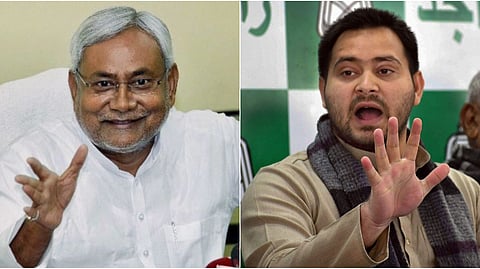
The INDIA bloc has also decided to try something different for the upcoming polls. A joint press conference by the alliance declared Opposition Leader in the Bihar Assembly Tejashwi Yadav as the CM face and Mukesh Sahani as the Deputy CM face. This created pressure on the NDA to declare its CM face. However, Amit Shah, who was in Patna for a couple of days to bring seat-sharing disputes within the NDA coalition under control, decided against officially naming anyone for the top post. For his part, Nitish did not succumb to the pressure of Amit Shah and refused to withdraw JDU candidates in five seats against the LJP (R). If Nitish is not declared the CM face, it may not be a surprise if he joins hands with the INDIA bloc after the elections.
The entry of Prashant Kishor's Jan Suraaj Party into Bihar's electoral fray is an interesting phenomenon. He began his political journey as an election manager with various political parties. Therefore, his ideological credentials are flexible too. He was made vice president of the JDU in 2018 on the advice of Amit Shah, but could not survive there. Kishor has been moving from village to village to understand Bihar for the last three years before launching his party on October 2 last year. His promise that day to lift the liquor ban in the state suggested that he has failed to understand its implications on women voters.
Since he is a fresh face in politics, he may corner a few votes but is unlikely to win many seats. As the margin of victory in Assembly polls can be small, it will not be a matter of surprise if the votes snatched by the JSP make it difficult for others to win. Kishor has attacked ministers in the Nitish cabinet on charges of corruption. But his party may end up dividing secular votes to benefit the BJP, given that Nitish lost his secular image in the eyes of Muslim leaders after his open support to the Waqf Bill in Parliament.
The NDA government in the state has been trying to woo voters with doles at the eleventh hour. 100 lakh women voters (75 lakh women by the Centre and 25 lakh women by the state) have been directly paid Rs 10,000 as a loan to encourage entrepreneurship among women, which could potentially be increased to Rs 2 lakh at a later stage. Besides this, old age pension has been increased from Rs 400 to Rs 1100, while cooks in schools have been given an enhanced salary. PM Modi also promised one crore jobs in the next five years.
These actions were countered by promises of the INDIA bloc -- one government job to each household, permanent job to jeevika didis (women associated with self-help groups) along with an increased monthly salary of Rs 30,000, besides waiving interest on existing loans taken by them. However, one has to wait and watch to see if voters, especially women, will cross caste lines and be influenced by these promises.
Amid the hurly-burly of the campaign, the broader trends emerging in the electoral landscape do not bode well. The number of candidates per assembly constituency has been declining with a few exceptions despite the fact that the number of political parties has increased significantly. The rise of coalition politics has reduced the opportunities of becoming a contestant. Further, parties now also examine how much money candidates can bring to the coffers. The Election Commission has also been increasing the deposit amount, which restricts the less privileged, even if they are party workers, from participating as bona fide candidates. Citizens have now been reduced to mere voters. Moreover, doubts raised by the Opposition on EVMs have made elections a game of political uncertainty for the public, which is reflected in the declining number of independent candidates and increasing number of NOTA votes.
(The author is former director, A N Sinha Institute of Social Studies, Patna, and now associated with Development Research Institute, Jalsain. Views are personal.)
