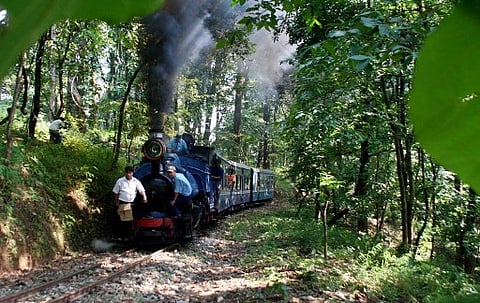

In the heart of the Darjeeling Himalayas, where the mist still clings to the slopes and the distant whistle of a train once sang through the valley, lies a relic of India’s glorious railway heritage — the Darjeeling Himalayan Railway (DHR). Declared a UNESCO World Heritage Site in 1999, the DHR is renowned for its world-famous Toy Train, a symbol of colonial engineering brilliance and mountain charm. It was the first mountain railway in India to earn this prestigious title, standing as a living monument to human perseverance and technological artistry.
But today, that proud legacy stands on the brink of silence. The rhythmic clang of metal, the hiss of steam, and the hum of workers that once defined the Tindharia workshop have all faded into memory. What was once the beating heart of the DHR has become a ghost of its former self — its rusting engines and abandoned machines whispering stories of neglect and lost glory.
Established in 1880 and expanded in 1915, the Tindharia workshop was once the powerhouse where steam locomotives and carriages were crafted, repaired, and reborn. It was not just a workshop; it was a monument to precision, craftsmanship, and dedication. Generations of skilled workers — mechanics, fitters, and engineers — poured their lives into keeping the Toy Train alive. At its peak, nearly 350 workers gave soul to the sound of hammers and sparks of metal that echoed across the hills. Today, only a handful remain, tending to three locomotives — 801, 802, and 806 — their weary hands holding onto a fading dream.
The decline of Tindharia mirrors the decline of an entire heritage. The museums built to preserve this century-old history at Tindharia, Sukna, Kurseong, and Ghoom once stood as proud custodians of India’s railway legacy. They held the brass bells that once rang before train departures, the lanterns that guided journeys through the dark, the leather bags used by guards, and even the palanquins that carried British officers. But now, those relics lie covered in dust. The Tindharia museum has been shut down; its century-old treasures have been scattered or moved to Katihar headquarters under the North-East Frontier Railway. At Sukna and Kurseong, the exhibits barely draw a handful of curious visitors. Even the Ghoom museum, perched at one of the world’s highest railway stations, sits neglected, its star exhibit — the “Baby Sivok” steam engine — rusting quietly under the Himalayan drizzle.
Perhaps the most painful symbol of this neglect is the oldest steam engine of the DHR, built in 1881 — a mechanical marvel that once defined the Toy Train’s spirit. After being painstakingly restored to working condition last year, it now lies abandoned again at the Tindharia workshop, exposed to the monsoon rains and harsh sun. The sight of this engine, once a proud emblem of progress, now corroding in silence, is enough to break any heart that remembers the magic of those miniature locomotives snaking through the clouds.
Not far away, in Kurseong, the old railway printing house tells a similar story. Once alive with the whir of machines printing tickets, manuals, and time charts for the railways, the building has been lying abandoned since its closure in 2018. The Railway Board sanctioned ₹5 crore for its modernization, but nothing changed. The roof leaks, the walls crumble, and another priceless chapter of India’s industrial history teeters on the edge of oblivion.
Recently, the Darjeeling Himalayan Railway proposed converting this printing house into India’s first Traditional Railway Heritage Institute — a centre for preserving and teaching the old skills of maintaining historic lines and engines. The proposal, approved by the North-East Frontier Railway, now waits in Delhi for final clearance. If implemented, it could become a revival point not just for DHR, but also for other UNESCO-tagged mountain railways like the Nilgiri Mountain Railway and Kalka–Shimla Railway. Yet, like the rest of the system, it too waits — for attention, for urgency, for care.
The problem is deeper than just broken walls or idle engines. The men and women who once breathed life into these machines are vanishing. Skilled artisans, who could tune a steam boiler by ear or mend an ancient coupling by hand, are retiring without successors. Their knowledge — passed through experience rather than textbooks — is being lost with every passing year. Without them, even if the engines remain, the soul that ran them will disappear forever.
And yet, amid this quiet decay, a glimmer of hope flickers. The DHR has begun the process of bringing back an old steam engine from Delhi, one that spent decades as a showpiece at Rail Bhavan and the National Railway Museum. The goal is to restore it, test it, and breathe new life into its iron heart. “Once it’s tested and refitted, we’ll try to start it again,” says DHR Director Rishabh Chowdhury. If successful, this small step could reignite a long-forgotten spirit — the romance of the Toy Train that once captivated the world.
The Tindharia workshop, with its century-old machinery, deserves far more than abandonment. With sincere government attention and dedicated restoration, it could become one of India’s finest heritage museums — a living tribute to railway history where visitors could see, touch, and feel the legacy of an era that built modern India. It could attract tourists, historians, and railway lovers from across the world, turning decay into pride and silence into song once again.
For now, however, the ghosts of Tindharia wait. The clang of hammers has long ceased, the smell of coal smoke is gone, and the once-busy corridors echo only with the wind. But the story is not yet over — if the government listens, if preservation takes precedence over neglect, then perhaps one day, the Toy Train’s whistle will once again echo proudly across the misty hills of Darjeeling — not as a sound of nostalgia, but as a symbol of rebirth.
(The author is former Professor of Political Science, Chanchal College, Malda)