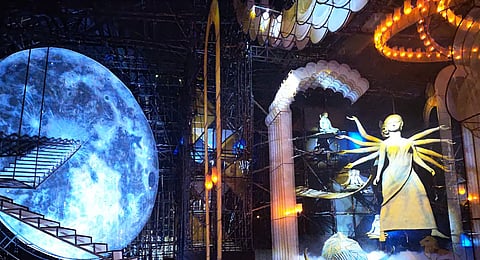

"Will we now have to buy tickets to see Ma Durga?"
This angry question came from a woman in her 40s, standing with her young daughter of perhaps 10 or 12 outside a towering puja pandal at Kendua in south Kolkata last Sunday the 21st, a whole week before the Durga Pujas officially began on 28 September.
I squirmed.
The question was not directed at me, but certainly a snide comment meant to be heard by my friend. She had bought tickets on a link, which you could reach via a food platform app, to gain early access to the Kendua Shanti Shangha pandal and the idol of Goddess Durga inside it as they had both been created by Susanta Shibani Paul, one of Kolkata's top Durga Puja artists.
She wanted to view his creations at leisure, without battling the most daunting thing about the festivities—the surging crowds that swamp the streets once the four-day festival begins in right earnest. At the pandal's entrance someone scanned the QR code on my friend's phone and, minus crowds and queues, we walked in.
The irked woman could clearly have afforded to buy a ticket on the spot—under Rs 100 per person—and entered the pandal as smoothly as my friend and me. But she did not. She stood at the entrance, a picture of defiant outrage that the Durga Pujas, the festival that defines being Bengali, is turning into a ticketed event where you pay to see Ma Durga.
Did I share that twinge of outrage too? I confess I did. What? Pay to see Ma Durga? How utterly absurd? I have been going to Puja pandals all my life. For free. Why should I pay now?
What the irate mother nor I acknowledged at that moment is, the Durga Pujas of Kolkata have, a long time ago, stopped being an annual 'para' or community event when neighbours came together to worship the goddess.
Today, the Durga Pujas of Kolkata have exploded into a phenomenon that brings an estimated 30 million people out on the streets of the city over seven days, many times more than the turnout at what is officially the world's biggest festival: the Rio Carnival. It has also spawned an economy bigger than that of many small countries.
In 2019, a study valued the creative economy generated by the Pujas at Rs 32,000 crore. Today, some puja pundits say it is closer to Rs 1,00,000 crore. And inarguably, the Durga Pujas of Kolkata is the largest open-air exhibition in the world of the most incredible, unique art. All of this was recognised by UNESCO, which in 2021 gave it the stamp of Intangible Cultural Heritage of Humanity.
Surely, something's got to give.

The preview pass
This time round, only one artist, Susanta Shibani Pal, has taken the individual initiative to ticket his creations at three pandals across the city, including Kendua Sangha. But Durga Pujas are on the fast track to becoming more monetized and commercialised and commodified than ever before. Not the worship of the goddess, mind you.
The religious part of the festival remains free, as always, for all. No one is charging anything for worshipping the goddess on the five days of the festival—Shashti, Saptami, Ashtami, Nabami and Dasami. What is happening is, for four or five days a week before the religious part of the festival begins, pandals are throwing open their gates to people who want to come and appreciate the creative and artistic component of the Durga Pujas. At a price.
"I am the one who started the ticketing concept. I am the one who said people should pay. How much longer will we pass it off as pujo? Every art show in the world is ticketed. So why not Durga Pujas?"
Thus boasts Dhrubojyoti Bose who helms the north Kolkata Durga Puja at a park called Tala Prattoy that he has pulled out of obscurity and turned into one of the top three pujas in town for the last five years at least. It is not an empty boast. Better known simply as Shubho, this market-savvy entrepreneur in his early 40s set the ball rolling in 2019 when he declared the festival must be treated as a marketing opportunity.
In 2022, he put his money where his mouth is. He launched MassArt which sent out beautifully designed "preview passes" to A-listers in the city and beyond to come visit two dozen of Kolkata's best pandals and Durga idols curated by his organisation over a four-day period a week before Shashti. The passes that year were complimentary and sent to diplomatic missions, influencers and other movers and shakers in the city. They came to the pandals in droves, delighted to view the magical art installations and have the artists give them a walkabout without having to push through enormous crowds or queue for hours.
By all accounts, the passes were free in 2023 as well. In 2024, some were sold for about Rs 1000 for two people to visit two dozen pandals over four days. This year, the MassArt passes are complimentary again. Not because Shubho was suddenly feeling altruistic but because he got three corporates to sponsor the passes for a "decent" sum of money. For the corporates, it was a powerful advertising medium to a very select A-lister consumers.
The model, says Shubho, is working. And he has numbers to prove it. In 2022, MassArt had issued 19,000 cards. In 2025, as per the data that hass come in so far, the number of "puja previewers" is around 3 lakh. "Today, there is a stampede for preview passes before the Pujas," says Shubho, who describes MassArt as a Durga Puja aggregator.
Mass Art or Class Art?
Mass Art has its critics. Those who claim the leitmotif of the strategy is politics, that all the Durga Puja pandals backed by Trinamool Congress leaders always make it to the MassArt list of must-see pujas and that those with a non-TMC allegiance don't. Political allegiance is also seen as influencing the awards lists, allegedly, with only politically correct pujas making it.
There are murmurs about rivals starting parallel preview packages to take on MassArt.
What MassArt has promoted very obviously is a VIP Durga Puja viewing culture. You can get dozens of VIP entry passes into Durga pandals that sell for a nominal fee and promise you speedy entry and exit at a pandal. They don't work, really, in my experience, as just too many people have them. But what it leads to is this: at least three passages into a pandal, divided by bamboo barricades.
One will be teeming with the masses who are constantly being harangued by untrained volunteers to hurry up and move on. Next to it will be passageway number two for VIP card holders, which is perhaps a little less crowded but by not much as everybody has bought or got the VIP access cards that makes you feel important but does little else. Finally, there will be a third passage for A-listers who get a ceremonial welcome—dhaak (drums), conch shells, daaber jol (green coconut water) and all—and are then be driven in a golf cart and dropped off virtually at the goddess' feet.
This has triggered the question, certainly on social media: is Durga Puja becoming an event for the elite while the masses are left to sweat it out for hours for a 30-second darshan of the goddess? This before being herded out by rude untrained volunteers that some social media commentators are describing as bouncers.
These debates are of no consequence for one of the most low-profile high-value initiatives by a Kolkatan to bring the world to witness Kolkata's marvellous Durga Pujas. This Kolkatan refuses to be named, refuses to let his/her organisation be named and refuses to share details of his/her three-year-old venture. But the initiative is giving high-end visitors from India and abroad a taste of the Durga Pujas combined with a taste of Kolkata, skilfully merging pandal visits with a walk down Park Street, a taste of street food, its arts and crafts and its colonial past. After beginning with 10 guests and growing to 200 last year, the guest list in 2025 is now 600 strong.
In this year's guest list are some Kolkatans, who now live abroad and have made it good. On this two nights and a day Durga Puja package, they are discovering a Kolkata they never knew.
The entrepreneur's refrain: Kolkata's Durga Pujas are a gold mine, commercially and artistically, and by bringing the world to it, the city and its people would benefit enormously.
The God-makers
Susanta Shibani Pal, the top Durga artist who has ticketed all his three creations this Durga Puja, is in full agreement with this unnameable entrepreneur and with Shubho of MassArt.
"If we want to take Durga Pujas to the world, ticketing is key. Before the religious part of the pujas begin, there must be privileged entry," says Pal. "For three-four days before the pujas begin, turn the art exhibition into a calendar event for the world to come and see."
Making money from tickets to pandals is still a sticky issue and Pal's ticket returns were all donated to charity. Money is not the point, he says. We must give people an opportunity to appreciate the art. Their creations will be on show for barely a week.
"According to some studies, people queue up at a pandal for 2-3 hours to enter a pandal and look at the goddess for just 30-40 seconds. That's just not enough time to appreciate art," Pal adds. "Some visitors who paid to view spent hours at my pandal taking photos, talking to me, asking questions. Nothing can give an artist more satisfaction."
Many of the questions Pal had to answer were about his walkout from Tala Prattoy Durga Puja after six successful years. Pal was Shubho's star artist. It was announced last year that Pal would helm the pujas in 2025 too. But something went awry. Not only did he quit Tala Prattoy, not one of the three Susanta Pal pandals are listed in MassArt's top 24 this year.
Bhabatosh Sutar has replaced Pal at the Tala Prattoy pandal inevitably, perhaps, as both of these graduates of the Government College of Art in Kolkata are considered the city's top artists and are, in fact, labelled "god makers". Sutar's creation at Tala Prattoy this year is titled "Beejgonit" (seed math) which the Chief Minister rechristened "Beejangan" (seed arena). In it, Goddess Durga is a majestic 25-foot idol, built in situ, and she is holding a plough, identifying the curse of hunger and the politics over food as the evil that Ma Durga must demolish.
In comparison to his lofty messaging, the debate over ticketed previews of Durga Pujas is inconsequential except for one thing. "Ticketing is the inevitable next step that the Durga Puja art festival must take to reach a global platform," says Sutar. "The Durga Puja organisers must handle the ticketing, however. Let the artists do their work."
Pandals bedazzle
Artists are delivering. The Durga pandals in Kolkata this time have moved on from simple themes of the past. I recall how pandals one year were all about the wonders of the world and resembled the pyramids, Taj Mahal, the great wall of China. Another year, a bunch of them were lookalikes of India's most beautiful temples. Or they celebrated some freedom fighter or the other.
Themes have come a long way since then. You do have the Operation Sindoor pandal inaugurated by Home Minister Amit Shah, but you also have one celebrating a 100 years of the circus in India, the Partition of Bengal, and the influence of Raja Ravi Varma on the way Hindu gods and goddesses look today.
This season, Kolkata's pandals have also discovered literature. Artist Anirban Pandalwala has brought to life the works of Leela Majumdar who wrote the most delightful stories for children. His Kashi Bose Lane creation in central Kolkata, which includes a live song-and-dance performance by theatre artists, is delightful and drawing enormous crowds. A couple of years ago, Anirban had swept the awards with an Abol Tabol pandal based on the nonsense verses of Sukumar Ray, Satyajit Ray's father, which is folklore in Bengal.
Byomkesh Bakshi, author Saradindu Bandopadhyay's detective immortalised in Bengali and even Bollywood cinema, is brought to life by Anirban at the Dum Dum Park Tarun Sangha pandal in north Kolkata as a graphic novel. Labelled one of Kolkata’s most creative pandals this season, an entire neighbourhood of 1940s Kolkata is created on canvas, complete with yellow taxi and a tram trundling down narrow streets. In this background, the tale of the dashing detective unfolds as he hunts down criminals.
An apt reminder in the Durga Puja season—that good always wins in the battle against evil.
Will we have to pay a price for this annual reminder?