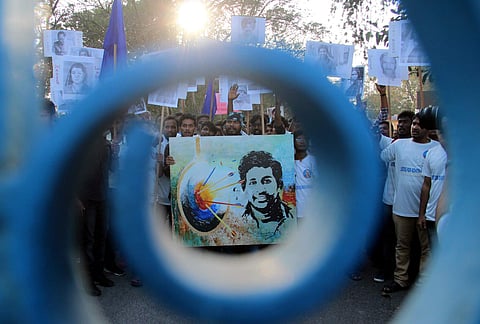

If Rohith Vemula were alive in 2026, he would be around thirty-six years old. One can imagine him as a teacher, a public intellectual, perhaps a scientist or a writer, someone still questioning power, still dreaming, and still believing that knowledge could be a tool for justice.
It was ten years ago, on January 17, 2016 that Rohith Vemula was institutionally murdered. His death exposed something far more unsettling: that universities, institutions often celebrated as spaces of reason and modernity, are deeply structured by caste.
It underlined that rather than merely reflecting social inequalities beyond their boundaries, universities actively perpetuate them within their classrooms, hostels, evaluation systems, and daily academic activities. Rohith’s death forced into public consciousness what Dalit students had long experienced in silence: that institutions can kill without ever touching the body.
When academia mirrors social hierarchies
Rohith Vemula’s experience at the University of Hyderabad made visible how institutional failure operates in caste terms. He questioned authority, challenged Brahmanical dominance, and insisted that equality was a right, not a favor.
The response was swift and disciplinary: suspension, social boycott, withdrawal of material support, and administrative indifference. The university did not engage with his ideas; it sought to silence his presence. His fellowship was stopped, his access to basic resources denied, and his social world deliberately narrowed.
The institution did not pull the trigger, but it created the conditions in which life became unbearable. Rohith’s death thus raised a question that still haunts Indian higher education: what happens when institutions meant to nurture minds instead systematically break them?
What makes caste discrimination in higher education particularly insidious is that it is rarely spectacular. Dalit students are not always abused openly; more often, they are quietly diminished. Their ideas are ignored in seminars until echoed by Savarna peers. Their academic labor goes unrecognised, while others receive praise for similar work.
They are marked lower in vivas and interviews without explanation and told they lack “clarity,” “rigor,” or “confidence.” Even discrimination has learned to speak the language of civility. The interview and viva systems, far from being neutral instruments of assessment, are structured through deeply embedded biases. They operate on unspoken assumptions about how intelligence should sound, appear, and be performed.
Fluency in dominant language registers, familiarity with elite academic culture and specific styles of self-presentation are regarded as indicators of merit, while alternative intellectual expressions are marginalised. In this way, interviews do not merely evaluate candidates; they actively regulate who is deemed academically legitimate, reproducing exclusion through procedure rather than through openly articulated discrimination.
Marginalised students, particularly first-generation learners, enter these spaces already marked as out of place. Failure is then framed as individual weakness, never as institutional bias.
The myth of merit and the reality of privilege
Merit in higher education is commonly framed as a neutral, objective, and caste-free measure of individual ability. This assumption, however, obscures the social conditions under which merit is produced, recognised, and rewarded.
Far from being an autonomous attribute, merit is a socially mediated construct that reflects the unequal distribution of social and cultural capital structured by caste hierarchies. According to French sociologist Pierre Bourdieu, intergenerational accumulation of cultural capital, linguistic competence, academic disposition, confidence, and familiarity with institutional norms aligns with dominant caste practices.
In the Indian context, this capital is explicitly caste-structured: Savarna students enter educational institutions already equipped with embodied dispositions that institutions mistake for intelligence and competence. Dalit students, often first-generation learners, encounter the university as a culturally alien space where evaluative norms are implicit yet rigid, producing systematic misrecognition rather than neutral assessment.
Meritocratic evaluations also erase the role of social capital, including access to mentorship, academic networks, and informal guidance. These resources significantly shape academic performance and institutional navigation but remain invisible within formal assessment frameworks. By ignoring such structural advantages, merit discourse converts inherited privilege into individual achievement and structural exclusion into personal failure.
Merit thus functions ideologically by naturalising inequality and moralising hierarchy. Success appears deserved, while exclusion is attributed to lack of effort or ability, absolving institutions of responsibility and delegitimising claims for structural redress. In this sense, merit operates as a technology through which caste privilege reproduces itself under the guise of fairness and modernity. This sustained misrecognition constitutes a form of institutional violence.
When exclusion is repeatedly framed as individual inadequacy, humiliation becomes normalised and structural discrimination rendered invisible. Merit, in this formulation, is not the absence of caste but one of its most effective contemporary languages, reproducing hierarchy while disavowing it.
From embodiment to institutional murder
Institutional murder is not an isolated act of individual cruelty; it is the terminal effect of a prolonged regime of humiliation embedded within institutional life. This regime operates through the everyday normalisation of Brahmanical embodiment and the systematic disembodiment of Dalit students in higher education.
Brahmanical embodiment structures the university as a space where savarna aesthetics, taste, comportment, and affect are treated as neutral standards of merit and professionalism. These embodied norms confer automatic legitimacy on Savarna bodies while rendering Dalit bodies culturally and epistemically misaligned with the institution. As a result, Dalit students encounter the university not as a space of recognition but as a site of constant correction, surveillance, and disciplining.
This process produces institutional humiliation. Humiliation here is not episodic or interpersonal; it is cumulative and structural. It is enacted through repeated questioning of competence, the delegitimisation of lived experience as knowledge, aesthetic policing of language, dress, and emotion, and the persistent marking of Dalit students as “quota,” “beneficiaries,” or disruptions to academic order. Each instance may appear minor or deniable, but together they constitute a continuous assault on dignity.
Institutional humiliation functions through disembodiment. Dalit students are compelled to suppress their histories, affects, and cultural presence to survive academically. Their bodies are present but unrecognised; their voices are audible but unauthoritative. This forced erasure generates what can be understood as social death within the institution, a condition where one exists without belonging, visibility without recognition, and participation without dignity.
When administrative indifference, disciplinary excess, and moral abandonment compound this prolonged humiliation, institutional murder emerges. When grievances are ignored, when discrimination is reframed as lack of merit or discipline, and when students are isolated rather than supported, the institution effectively withdraws the conditions necessary for life with dignity. Death, in such contexts, is not accidental; it is structurally produced.
The case of Rohith Vemula makes visible this continuum: from aesthetic and epistemic exclusion to institutional humiliation to enforced isolation and finally to death. His assertion that “birth is his fatal accident” names caste as the underlying structure that renders some lives institutionally unlivable.
Institutional murder, therefore, is not simply about physical death but about the systematic destruction of personhood through caste practices in institutions. Higher education institutions that normalize Savarna embodiment while disembodying Dalit presence actively participate in a regime where humiliation accumulates, dignity erodes, and survival itself becomes precarious. Institutional murder is the most extreme outcome of this regime, but its foundations lie in the everyday, normalised practices of caste power.
Émile Durkheim’s sociological understanding of suicide reminds us that such deaths often signal a failure of society itself, a failure to integrate, protect, and value certain lives. When institutions consistently deny recognition and belonging, they create conditions where survival itself becomes a struggle.
From hope to isolation: The broken promise of higher education
For many Dalit families, entry into higher education carries the weight of generations. A university seat represents dignity, mobility, and escape from caste-based structures. However, for many students, this dream quickly turns into isolation.
Support systems are absent, peers are distant, and institutions respond to distress with silence or suspicion. Universities increasingly function as spaces where Savarna students experience affection and belonging, while marginalised students experience distance, scrutiny, and neglect. Survival becomes emotional before it is academic.
The reality of caste discrimination in higher education is not undocumented. The SK Thorat Committee Report (2007) and the Mungekar Committee (2012) clearly identified systemic bias in elite institutions, from admissions to evaluation to faculty recruitment. These reports emerged from evidence, not ideology. Yet, their recommendations remain largely unimplemented. The problem, then, is not lack of knowledge but lack of political will.
Patterns of exclusion in academia
From Rohith Vemula to Payal Tadvi, from Darshan Solanki to countless unnamed Dalit workers and officers within state institutions, deaths linked to institutional humiliation continue to recur not as aberrations, but as a pattern.
Recent cases, including that of a Dalit woman student in Himachal Pradesh who, after enduring sustained sexual, mental, and caste-based harassment by a professor and peers, ultimately lost her life, expose how deeply entrenched caste violence remains within academic spaces and how the Dalit woman's body is repeatedly violated within institutions structured by caste power.
When institutions refuse to act, their silence does not remain passive; it becomes a form of violence, complicit in the reproduction of harm. Yet even within these hostile terrains, Dalit students continue to think, write, organise, and resist.
They emerge as organic intellectuals, producing knowledge grounded in lived experience and collective struggle. Their marginalisation is not the result of intellectual absence but a consequence of their disruptive presence, one that unsettles Brahmanical authority and challenges the moral economy of the university. Their exclusion is not due to intellectual absence, but because their presence unsettles privileged authority.
Conclusion: From stardust to justice
These experiences compel us to look beyond individual stories and examine the deeper social logic governing academic spaces. Caste does not disappear at the university gate; it reorganises itself through subtle hierarchies of recognition, belonging, and value. Discrimination often appears ordinary, procedural, and impersonal, making it easier to deny and harder to challenge. Yet it is precisely this ordinariness that allows institutional violence to endure.
Rohith Vemula understood this violence with painful clarity. In his final letter, he wrote that the value of a human being had been reduced to an immediate identity, to a number, to a thing, never treated as a mind, never as a glorious being made of stardust. His words remain not only a personal lament but also a structural indictment of institutions that continue to measure lives through caste while claiming moral neutrality.
When Shakespeare asked, "What’s in a name?" he could not have imagined a society where surnames decide dignity and destiny. In a caste society, a name can invite respect or ridicule, opportunity or exclusion. It silently announces caste, shaping how institutions respond to a body even before it speaks.
(Akhilesh Kumar is an Ambedkarite activist and a PhD scholar at Jamia Millia Islamia, New Delhi, at the Centre for Dalit and Minorities Studies. Views are personal.)
