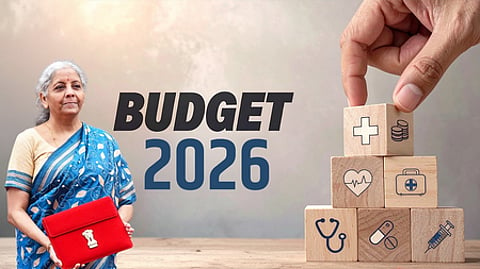

Budget 2026 needs to embed only one thing: a large dose of against-the-odds element to ensure economic triumph amid wars, geopolitical chaos and the changing world order.
If the Russia-Ukraine war divided opponents and supporters, the US is freshly thrusting its power onto Venezuela, Iran and now Greenland, all at once, tilting the balance of power. Clearly, the regular rules of global bonhomie, foreign policy, international trade and statecraft no longer apply and India needs to navigate carefully, keeping in mind that dangers foreseen are half avoided.
Helpfully, domestic macroeconomic indicators are holding promise, but the world is witnessing a chaotic reshuffle with a direct bearing on the global economy. It means, Finance Minister Nirmala Sitharaman's ninth consecutive budget must have M Night Shyamalan-style supernatural plots and twists to withstand and overcome unforeseen global macroeconomic challenges.
That said, the forthcoming budget, like its previous editions, may retain focus on three broad themes: capital expenditure to support job creation, targeted social sector spending, and a renewed push on structural reforms. In fact, the government's focus has remained solely on these three pillars over the past decade and budget 2026 is unlikely to reset that direction. But what could perhaps bring a Baahubali-like gamechanger is targeted, sector-specific measures to ensure that overall industrial growth remains resilient and inclusive.
Infrastructure is a critical focus area. While capital expenditure has been the defining feature of Sitharaman's budgets, private investments remain elusive. Investments in roads, railways, ports, airports and digital infrastructure will ensure India’s competitiveness and advance its manufacturing ambitions, but first, the government must redefine schemes such as the Production Linked Incentive scheme, moving away from capacity creation to deeper supply-chain integration, technology adoption and MSME participation for broader reach and efficient gains. The government did attempt to revive manufacturing, but these efforts were inadequate and feeble and need a complete rethink.
If infrastructure and manufacturing sectors are two key aspects, other thrust areas include rural development, job creation and income support. The government is reportedly planning to increase spending on rural development. For instance, the ministry has an outlay of Rs 1.88 lakh crore for FY26, up nearly 8% over the previous year, but needs a significant increase next fiscal for better outcomes.
Within the Ministry of Rural Development. three schemes, namely, MGNREGA, PMAY-G and PMGSY with an outlay of Rs 86,000 crore, Rs 54,882 crore and Rs 19,000 crore, respectively, account for about 85% of the total outlays by the Ministry. Importantly, MGNREGA is set for a complete overhaul with the Viksit Bharat Guarantee for Rozgar and Ajeevika Mission with an estimated outlay of Rs 95,000 crore is set to replace the rural employment guarantee scheme in FY27.
Likewise, other schemes such as rural housing and roads should be saddled with sacks of cash as they have a high multiplier effect.
As for jobs, the PM Internship Scheme (PMIS) should be given fresh wings, thanks to poor adoption and high dropout rates. Expectedly, the government is considering revamping the scheme, widening the participation of job seekers from the current 21-24 years to 18-30 years, more than doubling the stipend from the current Rs 5,000 per month and increasing the number of companies offering training from about 500 to about 6,000.
Coming to taxation, both direct and indirect tax regimes need changes to create an efficient tax ecosystem that is simpler and predictable.
As for personal income taxation, Sitharaman did liven up hopes with tax cuts just last year. Still, speculation is rife on social media that the FM may consider making Rs 17 lakh income tax-free in the forthcoming budget. Last year, income up to Rs 12 lakh was made tax-free under the new regime, which means, taxpayers can virtually get Rs 17 lakh tax-free by claiming deductions and maximizing allowances. If not this, they at least expect Sitharaman to increase standard deduction from the current Rs 75,000 to between Rs 1 lakh and Rs 1.5 lakh.
The government didn't give any feelers, but an entirely new tax filing concept is doing the rounds. The idea was proposed by the Institute of Chartered Accountants of India (ICAI), and anticipation is building that India may soon introduce a new joint filing system for couples, deviating from the current norm of individual taxation, with separate exemption limits and deductions for each taxpayer.
Currently, married couples file and pay taxes separately, even after sharing income, expenses, and financial obligations. The ICAI proposed that joint tax filing may help reduce the overall tax outgo, particularly for those with a single income and where one spouse earns significantly more than the other.
It recommended the basic exemption limit under joint taxation be doubled with income up to Rs 8 lakh to attract no tax, while applying it progressively to higher slabs. It must be noted that joint filing isn't effective for high-income earners. It'll be interesting to see if Sitharaman pursues such an option.
Meanwhile, tax litigation remains a challenge with over 5.4 lakh pending appeals, according to KPMG. It sought the need for faster disposal and clarity and simplification in tax laws, including several GST-related measures to help improve cash flows, reduce disputes, and enhance ease of doing business.
Coming to social sector spending, the allocations may retain trendline growth rates, which means they remain inadequate. Take healthcare. The globally accepted norm for government spending on healthcare is 3% of GDP, but even the FY26 budget allocation of Rs 99,859 crore comes nowhere near. Moreover, public spending remains below our own National Health policy's target of 2.5% of GDP.
Similarly, expenditure on education has been falling behind the benchmark 6% target for decades. First mooted by the Kothari Commission in 1968, and endorsed by subsequent National Education Policies, the 6% target continues to be out of bounds. In FY26, the earmarked Rs 1.28 lakh crore budget accounted for about 2.5% of the total government expenditure.
Ditto with agriculture. There have been drumbeats about an unprecedented, five-fold growth in agri budget between FY14 and FY23 from Rs 21,933 crore to Rs 1.38 lakh crore, or 3.4% of total expenditure in FY23, but agricultural reforms are a contentious area. As for the promise of doubling farmers' income, the jury is not out.
Lastly, all that matters for investors is policy predictability and fiscal discipline. Morgan Stanley expects India’s fiscal consolidation to continue in FY27, albeit at a slower pace, with the central government likely to peg the fiscal deficit at 4.2% of GDP as against 4.4% in FY26. This would mark the shallowest pace of consolidation since FY23. The good news is, the deficit target of 4.4% will likely be met, notwithstanding low nominal GDP and higher capital expenditure.
Meanwhile, FY27's 4.2% deficit may reduce central government debt down to about 55.1% of GDP from an estimated 56.1% in FY26. The distinguishing feature of the forthcoming budget will be India's shift from deficit tracking to debt reduction. As Sitharaman had announced in the past, the government will pursue the consolidation of debt-to-GDP ratio to about 50% by FY31. Similarly, net borrowing may remain broadly stable at Rs 11.6 lakh crore in FY27, marginally higher than Rs 11.5 lakh crore in FY26, while gross borrowing may rise to Rs 15.8 lakh crore due to higher redemptions.
Beyond numbers and allocations, Budget 2026 must have a strong signal of intent indicating our commitment to strengthen India's role in global manufacturing and infrastructure-led growth, which alone can create jobs and improve livelihoods.
