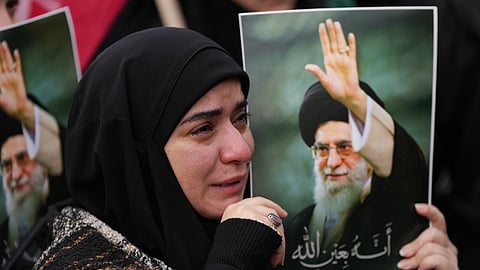

The killing of Iran’s Supreme Leader, Ayatollah Ali Khamenei, in a joint US-Israeli strike marks a turning point for Tehran and the wider West Asia. At 86, Khamenei leaves behind a legacy that is as much about strategic endurance as it is about intense debate surrounding him.
For decades, he was the linchpin of a political-religious system that combined spiritual authority with concentrated state power, shaping Iran’s domestic and foreign policy in ways few leaders could in modern times.
Khamenei assumed the supreme leadership in 1989 after the death of Ayatollah Ruhollah Khomeini, the charismatic revolutionary who overthrew the Pahlavi monarchy. While Khomeini’s vision sparked the Islamic Revolution, it was Khamenei who built the institutional machinery to sustain it. He expanded and strengthened the military and paramilitary apparatus, especially the Islamic Revolutionary Guard Corps, ensuring that Iran could defend itself while projecting influence and power far beyond its borders.
Before becoming supreme leader, Khamenei was president during the Iran-Iraq War of the 1980s, a grueling conflict that cemented his mistrust of the West, particularly the United States. That period shaped his worldview — that a nation under siege could survive only by cultivating internal cohesion, strategic depth, and convenient regional alliances. Over time, he translated that philosophy into a doctrine of resistance, positioning Iran as a regional power willing to stand firm against external pressures.
Under his leadership, Iran pursued a controversial nuclear program, a point of intense friction with the West. To supporters, it was a bargaining chip and a symbol of sovereignty; to critics, it was a destabilizing provocation that invited sanctions, isolation, and military threats. Beyond nuclear policy, Khamenei expanded Iran’s reach through a network of allied groups — Hezbollah in Lebanon, Shiite militias in Iraq, and the Houthis in Yemen — creating the so-called “Axis of Resistance.” Through these alliances, Iran projected power across West Asia, influencing conflicts and diplomacy alike.
Yet Khamenei’s final years exposed the system’s vulnerabilities. Decades of sanctions had left the economy strained and drained, and the youth disillusioned. Regional conflicts, including the 2023 Hamas-Israel confrontation and subsequent Israeli strikes against Iranian-backed proxies, challenged Iran’s strategic depth. Negotiations with the United States over nuclear limitations appeared promising, only to be overtaken by the February 28 strike. Strange as it may sound, this perhaps underlined the perilous balance between deterrence and escalation that Khamenei had long navigated.
Khamenei’s supporters remember him as a fearless leader who prioritized national sovereignty and inspired loyalty. Critics view him as a consolidator of power whose policies entrenched authoritarianism, curtailed freedoms, and left Iran isolated. Both views acknowledge his imprint on the state — a leadership defined by survival, influence, and a readiness to confront enemies directly.
Khamenei was only the second leader of the Islamic Republic, but by far its longest-serving. He shaped the national psyche, forged a distinct foreign policy, and presided over a system resilient to both external pressures and internal dissent, often enforced through strict crackdowns. His passing marks not just a personal and political transition but a moment of uncertainty for West Asia, where Iran has acted as both stabilizer and disruptor. Khamenei’s legacy blends defiance with pragmatism, regional ambition with domestic control. For decades, he anchored Iran’s identity to his own authority, projecting power abroad while suppressing dissent at home and shaping a system that could endure both external pressure and internal unrest. His rule leaves a nation resilient but constrained, and a region watching what comes next.
