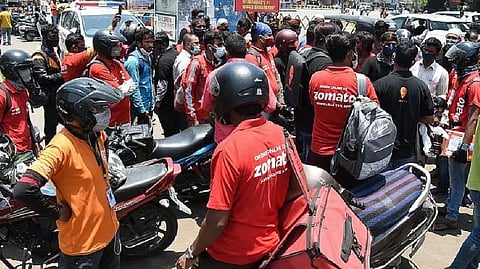

The domino effect of the ongoing conflict in West Asia and the subsequent shortage of LPG supplies has now hit the gig economy.
Food and grocery delivery workers are facing a threat to their livelihoods as restaurants shut down or cut back on their menus due to the LPG crunch.
Kuldeep, who works as a Swiggy delivery person in Delhi, said the orders he receives in a day have come down from the usual 20 to 22.
"Today I worked for four-and-a-half hours so far and got only six orders. I could earn only Rs 275, of which I used Rs 150 for fuel," he said, adding that he hopes to get more orders in the night.
He said around 30 to 40 per cent of restaurants have closed down, and sometimes he has to travel longer distances to pick up an order.
Satyabhan Singh, who is a gig worker for Swiggy and Zomato in the Delhi NCR region, had a similar tale to tell, with his orders being reduced by half.
"I used to deliver 25-30 orders a day, but now it has been reduced to 15 due to the LPG shortage," he said.
The price of commercial LPG has been increased to Rs 114 per cylinder, and that of domestic LPG has been increased by Rs 60.
Large metro cities where demand for food delivery and restaurant density is the highest are the hardest hit by the shortage.
"Cities like Delhi, Mumbai, Bengaluru, Chennai, and Pune appear to be among the most affected because a large number of restaurants, cloud kitchens, and street food vendors in these cities rely heavily on commercial LPG for cooking," said Nitesh Kumar Das, the organising secretary of the Gig Workers Association (GigWA).
GigWA is a collective of app-based and platform workers across India that works to raise the concerns of gig workers and advocate for fair working conditions, social security, and dignity of labour in the platform economy.
Restaurants are also struggling to prepare food on time as low gas pressure has been reported in cities where piped gas is supplied through pipelines.
Many restaurants are cutting down their menus and removing items that take longer to cook. "Food items such as dal makhni, kadhi, rajma, and certain non-vegetarian dishes are being removed from the list," Nitesh said.
Gig workers are also apprehensive about the possible shortage of petrol and diesel, which would affect the food delivery process and are queuing up at petrol stations.
The association said that immediate relief measures should be enforced to protect the workers.
"The Gig Workers Association has appealed to food delivery platforms like Swiggy and Zomato to introduce a temporary moratorium on all penalties, ensuring that gig workers’ ratings and earnings are not affected by delays or cancellations caused by restaurant closures or supply disruptions," said Nitesh.
"In the short term, we are also appealing to consumers to tip workers generously to help compensate for the loss of income as orders decline," he said.
The government should also invest in a support system for eateries, including street food businesses to transition to alternative source of energy like induction and solar, he added.
The lack of social security benefits and fair platform policies for gig workers makes them vulnerable to such crises.
Satyabhan said companies like Swiggy and Zomato do not give orders directly to their delivery agents but employ third-party delivery agents like Shadowfax and Uncle Delivery, making their situation difficult. He said, “We work for 15 to 18 hours a day, sometimes way beyond midnight. So the company should also look out for us, right?"
“We don't have any kind of support team to talk to," added Kuldeep, noting that their concerns go unheeded.
"Gig workers may still face penalties, rating reductions, or order cancellations from platforms despite the situation being beyond their control. Without formal social protection mechanisms, workers must bear the financial risks of such disruptions entirely on their own, pushing many into economic insecurity," said Nitesh.
Gig workers are paid on a task-based system and do not receive benefits like minimum wage guarantees, income protection, health insurance, or unemployment support. Any disruption in the food delivery ecosystem directly affects their livelihoods.
"When restaurants shut down, or orders decline due to supply disruptions such as the LPG issue, workers experience an immediate drop in earnings with no safety net to fall back on," Nitesh added.
