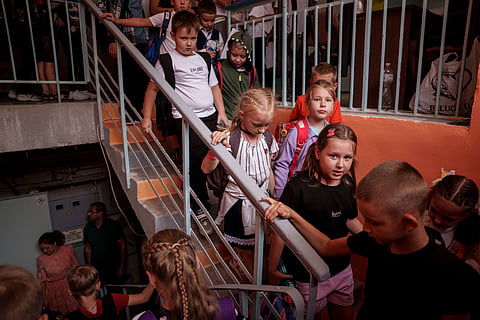

ZAPORIZHZHIA: Being a parent in the front-line city of Zaporizhzhia means weighing your child’s safety against the Russian weapons within striking distance.
Most can bring death in an instant: drones, ballistic missiles, glide bombs, and artillery shells. But Russian forces also control another weapon with the potential to be just as deadly: the nearby Zaporizhzhia nuclear power plant.
The NPP, as it’s known, once produced more electricity than any other nuclear plant in Europe. It fell to Russian forces in the early weeks of the full-scale invasion, and they have maintained control over its six reactors since. The plant has come under repeated attacks, with both sides blaming each other.
These twin dangers bombs and radiation loom over families in Zaporizhzhia. Most of the youngest residents of the city have never set foot in a classroom. Schools that suspended in-person classes during the COVID-19 pandemic more than four years ago continued online learning after the war began in February 2022.
With missiles and bombs still striking daily, Zaporizhzhia is embarking on an ambitious project to create an underground school system.
Construction has begun on a dozen subterranean schools designed to be bomb- and radiation-proof, capable of educating 12,000 students. Officials say they will subsequently focus on the hospital system.
The daily bomb threats are a more immediate fear than radiation, according to Kateryna Ryzhko, a mother whose children are the third generation in her family to attend School No. 88. The main building, dating back to the Soviet era of the children’s grandmother, is immaculate, but the classrooms are empty. The underground version is nearly complete, and Ryzhko expressed her willingness to send her kids there. Nearly four years of online learning have taken their toll on children and parents alike.
“Even classmates don’t recognize each other,” she said. “It’s the only safe way to have an education without being on screens.”
Nuclear Shadow
Within days of Russia’s full-scale invasion in February 2022, Zaporizhzhia’s 300,000 residents found themselves on the front lines. Unlike larger Ukrainian cities like Kyiv or Kharkiv, there is no subway system that could serve as a bomb shelter, and few schools had basements for safer classes.
Many residents left—though some have returned. However, the single-family homes and Soviet-style apartment blocks of Zaporizhzhia, the capital of the region of the same name, filled quickly with Ukrainians fleeing areas seized by Russian forces, such as Mariupol, Melitopol, and Berdyansk.
By the start of the school year in September 2022, which was meant to mark a return to classrooms post-pandemic, schools were empty. Windows were boarded up to protect against bomb shockwaves, and the lawns were left unkempt. Fifty kilometers (31 miles) away, the nuclear reactor went into cold shutdown after intense negotiations between the International Atomic Energy Agency (IAEA) and the Russian government.
The IAEA has rotated staff on site since then. There are risks even in cold shutdown, when the reactor operates without generating power. The main danger is that its external electrical supply, sourced from Ukrainian-controlled territory under constant Russian bombardment, could be cut off for longer than backup generators can handle.
The nuclear plant requires electricity to keep crucial backups functioning, including water pumps that prevent meltdowns, radiation monitors, and other essential safety systems.
During a recent Associated Press trip to the Ukrainian-controlled zone nearest the nuclear plant, two airborne bombs struck electrical infrastructure within minutes as night fell. Russia has repeatedly targeted Ukraine’s grid, and these attacks have intensified this year. In a stark reminder of the constant danger, electricity to the NPP was cut off again for three days while emergency workers struggled to extinguish a fire. This marked at least the seventh time this year that the plant had been reduced to relying on either a single electrical line or generator power, according to the global Nuclear Energy Agency.
“Nuclear power plants are not designed to be disconnected from the grid. It’s also not designed to operate in cold shutdown for extended periods,” said Darya Dolzikova, a researcher on nuclear policy at the Royal United Services Institute in London.
Ukrainian President Volodymyr Zelenskyy has accused Russia of deliberately targeting nuclear plants. The 1986 meltdown in Ukraine’s Chornobyl, located nearly 900 kilometers (550 miles) from Zaporizhzhia, increased rates of thyroid disease among Ukrainian children far from the accident site and contaminated the immediate surroundings before spreading over much of the Northern Hemisphere. Today, the area around Chornobyl remains an “exclusion zone,” accessible only to technical staff necessary for maintaining safety.
Russian forces seized control of Chornobyl in the early days of the invasion, only to be driven back by Ukrainian forces.
While the Zaporizhzhia plant has a safer, more modern design than Chornobyl, experts say it doesn’t eliminate risk entirely, and Russia will remain a threatening neighbor even after the war ends.
An investment that might seem extreme elsewhere is more understandable in Ukraine, according to Sam Lair, a researcher at the Center for Nonproliferation Studies.
“They are under conventional air and missile attack from the Russians, and they know those attacks aren’t targeting only military sites,” Lair said. “If I were in their position, I would be building them too.”
Additionally, the Zaporizhzhia region received a European Union donation of 5.5 million iodine pills, which help block the thyroid’s absorption of certain radiation.
Since the war began, Russia has frequently referenced its nuclear weapons stockpile without issuing direct threats. In September, Russian President Vladimir Putin stated that Russia would consider any attack by a country supported by a nuclear-armed nation as a joint attack and emphasized that Russia could respond with nuclear weapons to any attack posing a “critical threat to our sovereignty.”
Ukrainian officials fear that Russian attacks on Chornobyl and the Zaporizhzhia nuclear plants may be just the beginning. During his speech to the U.N. General Assembly in late September, Zelenskyy warned that Russia was preparing strikes on additional nuclear plants, which generate a significant portion of Ukraine’s electricity.
“If, God forbid, Russia causes a nuclear disaster at one of our nuclear power plants, radiation won’t respect state borders,” Zelenskyy said.
Underground for the Future
The cost of constructing a subterranean school system is enormous—the budget for the underground version of Gymnasium No. 71 alone exceeds 112 million hryvnias ($2.7 million). International donors are covering most of the cost, and the national and local governments have prioritized this alongside funding for the military.
“Everybody understands that fortification and aid for the army is priority No. 1,” said Ivan Fedorov, head of the Zaporizhzhia region. “But if we lose the new generation of our Ukrainians, for whom are we fighting?”
Daria Oncheva, a 15-year-old student at Gymnasium 71, looks forward to attending underground classes, eager to finally be with her classmates.
“It’s safer than sitting at home remotely,” she said.
School No. 88, across town, is further along, with rooms already carved out and fully lined with concrete thick enough to block initial radiation exposure. The contractor leading the project is also digging trenches for Ukraine’s military. When completed, it will serve as the primary bomb shelter for the neighborhood, whose single-family homes typically lack basements but often feature small orchards and gardens.
An optimistic timeline has the school ready for children by December. It will incorporate three layers of rebar totaling 400 tons of metal, along with 3,100 cubic meters of reinforced concrete. The building will be topped with nearly a meter (yard) of earth, concealed by a soccer field and playground.
The school will also feature an air filtration system, two distinct electrical lines, and the capability to operate autonomously for three days, with extra food and water supplies.
Michael Dillon, a scientist at Lawrence Livermore National Laboratory who studies survival in nuclear fallout, noted that being underground improves survival odds by a factor of ten.
However, Alicia Sanders-Zakre from the International Campaign to Abolish Nuclear Weapons contended that ultimately, people could achieve more by eliminating these weapons instead of merely creating “a Band-Aid” for the real problem.
Lyudmila Zlatova, who has been the principal at School No. 88 for 30 years, hopes the new structure will be equipped to face the dangers Zaporizhzhia will encounter in the future. Yet, she and the parents gathered at the construction site are most concerned with present threats, especially as air raid sirens blared nearby.
It takes just 10 seconds for a bomb to reach the neighborhood from the front line far too short a time to evacuate and bombs land with unsettling frequency. The underground school’s sunless rooms and concrete corridors will help children feel more secure amid their ongoing struggles, Zlatova said.
“They will feel better studying without windows,” she remarked, gazing across the construction site.
Zlatova believes the new school will encourage at least some families who’ve left Zaporizhzhia for other cities in Ukraine or Europe to return. The city remains functional, with public transit, grocery stores, markets, and restaurants operating, alongside ongoing repairs to structures damaged by shelling—albeit in limited capacity. About 150 of the school’s 650 prewar students have left the city, but Zlatova is in contact with absent families, many of whom promise to return once a safe place to study is available.
Gymnasium No. 6, which serves students from first grade through high school, already has an underground facility. Its main building is located on the city’s easternmost edge, closer than any other school to the front, which is 40 kilometers (25 miles) away.
Little wonder that its principal, Kostyantyn Lypskyi, seems a bit frayed at the beginning of the academic year. However, his students can at least attend classes because parents contributed funds last year to renovate the basement shelter, about 50 meters from the main school building, into a series of classrooms.
His underground school, with concrete walls and relatively thin metal doors, is not radiation-proof but provides protection against explosions. It can accommodate around 500 people, which matches the capacity of the new designs. However, the school has double that number of students, so they will alternate weeks. The youngest children study full-time just upstairs from the shelter, while the older ones are in the main building.
“Of course it will work,” he said. “We’ve prepared everything for the start of the new school year.”
In the early days of the school year, an air raid alarm allowed him to test that confidence. It took five minutes from the moment the sirens sounded until the last children took their seats and spread out their books, awaiting instruction. It was morning, and they were ready for the day ahead.
