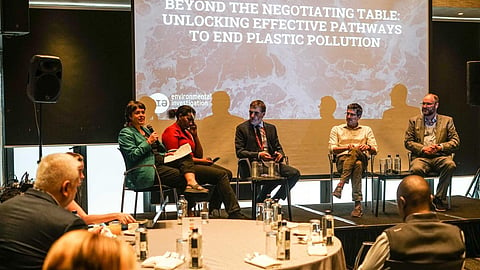

NAIROBI: Global efforts to craft the world’s first treaty to end plastic pollution are under mounting strain, with negotiators warning that the process is drifting from its mandate and risks delivering an agreement too weak to meet the scale of the crisis.
The concerns surfaced at a candid side event held on the margins of the UN Environment Assembly (UNEA-7) in Nairobi, where governments, experts and civil society reflected on the stalemate that marked the most recent negotiations, INC-5.2 in Geneva.
One senior negotiator said the process is now struggling to uphold the core mandate set out under UNEA Resolution 5/2. “We gave ourselves a mandate from 5.2,” they said.
“But we have a number of parties… who cannot live up to their mandate. For me it is hard to understand how we can live up to 5.2 if we have no global measures.”
Slow progress, procedural confusion and reluctance to address issues like hazardous chemicals in plastic products, they warned, have placed the negotiations in “quite a challenging situation.”
With a new INC chair to be elected next year, they urged clearer rules, stronger leadership and more informal consultations — and even floated alternative pathways through the Basel Convention or the UN General Assembly. “The bottom line is very clear: we need a plastic treaty.”
Rwanda’s Juliet Kabera, Director General of the Environment Management Authority and a leading voice in the High Ambition Coalition (HAC), said countries calling for strong global rules had repeatedly compromised. The coalition had even stepped back on positions related to primary plastic production, an issue she called “very important”, in an effort to bridge divides.
“However, this flexibility didn’t lead us to the finish line,” she said, warning that without an impartial process capable of reconciling competing economic and environmental concerns, “we might continue to be in this kind of stagnation”.
Dennis Clare, legal advisor for Federated States of Micronesia, however, saw some positives. One of the most significant political signals at INC-5.2 came from China’s closing intervention, which he described as unexpectedly “thoughtful and careful.”
According to him, Beijing acknowledged learning “what needs to be done in plastics,” recognised that pollution is emitted across the full life cycle, implying that upstream interventions may be required, but also stressed concerns about development needs and economic impacts.
“There’s an opening for a broader understanding of the life cycle,” Clare said, “but the question is always the pace. China has a huge industry; how fast they move depends on how their companies balance market needs.”
On India, Clare noted that while the country associated itself with the like-minded bloc, its economic landscape is far more diverse.
“The good news for India, like China, is it’s got a big giant diverse economy,” he said. India must balance its expanding petrochemical investments with environmental goals, but he stressed that “like-minded is the label — they’re not identically minded.”
The strongest criticism came from Tim Grabiel, Senior Lawyer and Policy Advisor at the Environmental Investigation Agency (EIA), who warned that the process is being undermined by actors “not negotiating in good faith.”
He cited a case at INC-5.2 where certain delegations’ positions were misrepresented to their capitals, causing “a lot of problems and a lot of paralysis.” He also warned that negotiators have “lost focus” on the treaty’s core purpose. Packaging, which accounts for 40% of plastics produced and 80% of plastic waste, is barely mentioned in the current Chair’s text.
During the launch event of UNEP’s Global Environment Outlook (GEO-7) report, one of the co-chairs Sir Robert Watson, replying to the question from TNIE, said there is mounting scientific evidence linking plastics to biodiversity loss and human health impacts.
“Plastic waste is having a significant effect… and we need to act,” he said, adding that circular economy approaches will be central for all materials. UNEP Executive Director Inger Andersen defended the pace of the INC process, noting that setting an ambitious timeline forced momentum. “We are making progress and no one has left the table,” she said.
While negotiations remain difficult, Andersen stressed that unlike some treaties, such as the Paris Agreement, which took 21 years, the plastic treaty process is still on track.
