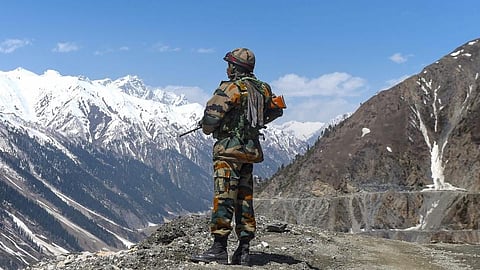

NEW DELHI: China is seeking to leverage reduced tensions along the Line of Actual Control (LAC) with India to stabilise bilateral relations and prevent a deeper strategic alignment between New Delhi and Washington, said the US Department of Defense’s latest annual report to Congress on China’s military and security developments.
The report, which outlines Beijing’s long-term strategic ambitions, says India remains wary of China’s intentions despite recent efforts at de-escalation. “India probably remains sceptical of China’s actions and motives. Continued mutual distrust and other irritants almost certainly limit the bilateral relationship,” it said.
At the core of China’s strategy, the report says, is President Xi Jinping’s vision of achieving “the great rejuvenation of the Chinese nation” by 2049. A rejuvenated China, it says, seeks to raise its “influence, appeal, and power to shape events to a new level,” underpinned by a “world-class” military capable of “fighting and winning” wars and resolutely safeguarding China’s sovereignty, security and development interests.
Central to this ambition are what Beijing defines as its three non-negotiable “core interests”: maintaining the Chinese Communist Party’s (CCP) control, promoting economic development, and defending and expanding China’s sovereignty and territorial claims. The Pentagon report notes that China’s leadership has steadily expanded the scope of these core interests to include Taiwan and contested territories in the South China Sea, the Senkaku Islands, and India’s Arunachal Pradesh.
“Chinese officials have described the unification of China and contested territories, especially Taiwan, as a ‘natural requirement’ for national rejuvenation,” the report says. It adds that the CCP is acutely sensitive to any perceived threats to its authority or criticism that it is failing to defend Chinese interests.
The Pentagon says Beijing routinely labels political opposition in Hong Kong, Xinjiang and Tibet as well as Taiwan’s leadership as “separatist elements” allegedly backed by “external forces.” Such groups, the report says, are viewed by the CCP as an “unacceptable threat to its legitimacy and power.”
The report also places India-China dynamics within the broader US-China relationship. It claims that under President Donald Trump’s leadership, ties between Washington and Beijing are “stronger than they have been in many years,” and says the U.S. Department of Defense will support efforts to build on this momentum. “We will do so in part by opening a wider range of military-to-military communications with the PLA, with a focus on strategic stability as well as deconfliction and de-escalation,” the report says, adding that the U.S. would also seek “other ways to make clear our peaceful intentions.”
At the same time, the Pentagon stresses that U.S. interests in the Indo-Pacific are “fundamental, but also scoped and reasonable.” “We do not seek to strangle, dominate, or humiliate China,” it says. “Rather… we seek only to deny the ability of any country in the Indo-Pacific to dominate us or our allies.” The Department of Defense says it will prioritise bolstering deterrence “through strength, not confrontation,” with the aim of sustaining a balance of power that preserves stability.
“President Trump seeks a stable peace, fair trade, and respectful relations with China,” the report says, adding that US military strength is intended to ensure that “peace is therefore preferred and preserved” in the Indo-Pacific.
