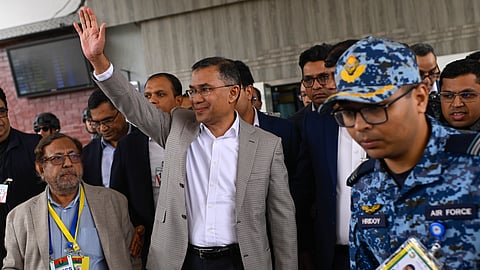

DHAKA: Aspiring prime minister and political heavyweight Tarique Rahman was welcomed back to Bangladesh on Thursday by huge crowds of supporters after his 17 years in self-imposed exile.
Rahman, the son of former prime minister Khaleda Zia and heir apparent of the Bangladesh Nationalist Party (BNP), shook hands with party leaders after touching down at the Dhaka airport.
Accompanied by his wife and daughter, he waved to supporters before ducking into a convoy under tight security, video posted by his party showed.
Since early Thursday, BNP-backers have been gathering in the capital, plastering the streets with banners and festoons bearing images of Rahman.
Patriotic songs blared from loudspeakers while cut-outs depicted Rahman riding a stallion.
Massive crowds of supporters spread through an area about 2 kilometers (1.2 miles) between the airport and a reception venue, where many had stayed overnight. A sea of people also waited at the venue. Rahman’s senior party leaders said earlier they expected “millions.”
Rahman moved to London in 2008 for medical treatment with permission after he was tortured while in custody during a military-backed government that ruled from 2006 to 2008.
Rahman is the acting chairman of the Bangladesh Nationalist Party, one of two major political parties in the South Asian nation of more than 170 million people. His return is seen as politically significant ahead of the next election set for Feb. 12 under the current interim government.
The February 12 general elections will be the first polls since ex-premier Sheikh Hasina's exit following a student-led uprising last year.
The BNP is widely seen as an election frontrunner, with Rahman expected to be put forward as prime minister if his party wins a majority.
After a reception, party officials said Rahman plans to go to a hospital to visit his critically ill mother, former Prime Minister Khaleda Zia, who led a coalition government from 2001 to 2006.
Rahman's ailing mother, 80-year-old former leader Zia, is undergoing treatment at a hospital in Dhaka.
Despite years of ill health and imprisonment, Zia vowed in November to campaign in the upcoming elections.
But she was hospitalised soon after making that pledge, and has been in intensive care ever since.
Zia, a former housewife, came to politics after her husband, former military chief and then President Ziaur Rahman, was assassinated in a military coup in 1981. A non-elected government backed by the military took over in 2006 during a period of political chaos.
Zia is considered one of two key figures in Bangladesh politics, along with Sheikh Hasina, who was sentenced to death in absentia in November. Hasina was convicted on charges of crimes against humanity involving the crackdown on a mass uprising that ended her 15-year rule in 2024. India has not approved requests to extradite Hasina since she fled there last year.
In recent years, Rahman has been a de facto leader of the Bangladesh Nationalist Party. He regularly joined meetings and rallies online from London, keeping his party united. He was not openly challenged by any party insiders during his absence.
Rahman's return comes after recent unrest over the killing of popular student leader Sharif Osman Hadi, a staunch India-critic who took part in last year's mass uprising.
Hadi, 32, was shot by masked assailants this month in Dhaka, and later died of his wounds at a Singapore hospital.
His death set off violent protests with mobs torching several buildings, including two major newspapers deemed to favour India, as well as a prominent cultural institution.
Bangladesh is now at a political crossroads. The country is run by an interim government headed by Nobel Peace Prize laureate Muhammad Yunus, but the administration is struggling to maintain law and order and restore confidence while attempting a return to democracy after Hasina's long premiership.
Global human rights groups including Human Rights Watch and the Amnesty International have criticized the Yunus government of shrinking democratic rights. Liberals in Bangladesh have expressed concerns over press freedom and minority rights and accused Yunus of presiding over a visible rise of Islamists.
Rahman supported Yunus when he took over as the government's chief adviser, but the relationship with his party remained shaky.
(With inputs from Associated Press, AFP)
