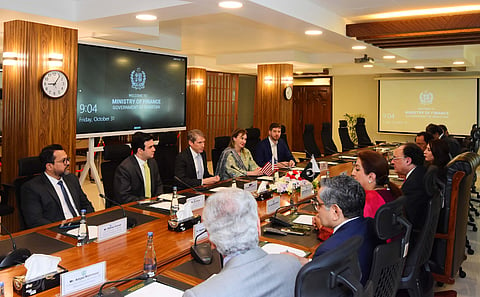

ISLAMABAD: A US delegation held talks with Pakistani officials to explore cooperation in the minerals and mining sector as Washington seeks to secure mineral supply chains for American industry amid concerns over China’s growing dominance in rare-earth resources.
The delegation, led by Critical Minerals Forum (CMF) chief Robert Louis Strayer II and US Chargé d’Affaires Natalie Baker, met with Minister for Finance and Revenue Muhammad Aurangzeb and his team on Friday.
According to an official statement, the US delegation “discussed avenues of cooperation in the minerals and mining sector, strengthening supply-chain security, and encouraging responsible and sustainable investment in Pakistan’s critical minerals landscape.”
Aurangzeb highlighted Pakistan’s ongoing structural reforms, fiscal discipline, and positive global outlook, emphasising that a robust minerals policy could drive export-led growth and long-term economic stability.
Both sides reaffirmed their commitment to continued engagement and collaboration aligned with Pakistan’s reform agenda and shared goals for sustainable development.
The Dawn newspaper reported that the CMF’s initiative is driven by the strategic challenge posed by Beijing’s control over key resources.
“China’s dominance of critical mineral supply chains has become a well-known threat to US national security, economic competitiveness, and long-term strategic objectives,” Strayer wrote in an article on the CMF website.
He told Pakistani officials that the CMF is working globally to support reliable supply chains for US industries, particularly in emerging markets. The forum focuses on rare and niche metals, including copper and antimony, and aims to reduce investment risks from both financial and security perspectives.
US stakeholders are increasingly concerned about China’s growing control over global critical minerals. Strayer noted that China’s dominance stems from government subsidies, vertical integration, and lax environmental regulations, especially in energy-intensive processing, contrasting with underinvestment in the United States.
According to the US-based Atlantic Council, critical minerals are foundational to the modern economy and state power, essential for technologies in energy, defence, and commerce — from fighter jet magnets to electric vehicle batteries.
The council warned that these supply chains have become “increasingly brittle,” concentrated in a few countries and overwhelmingly refined in China, leaving them vulnerable to disruptions and export controls.
It also noted that China has “weaponised its dominance,” tightening export restrictions on materials such as graphite and antimony in response to US trade curbs.
However, Strayer pointed out that uncertainty over production costs and mineral prices remains a major obstacle to US investment, as it discourages private companies from entering projects with unpredictable returns.
