
ROME: Firefighters late on Monday finally managed to extract a worker from beneath rubble inside a medieval tower that partially collapsed during renovation work in the heart of Italy’s capital, but the joy of that rescue proved short-lived.
The man did not withstand the trauma he suffered and died soon afterwards.
“I express deep sorrow and condolences, on behalf of myself and the government, for the tragic loss of Octay Stroici, the worker who was killed in the collapse of the Torre dei Conti in Rome,” Italy’s Prime Minister Giorgia Meloni said in a statement after midnight.
“We are close to his family and colleagues at this time of unspeakable suffering.”
Images broadcast on local television showed a group of rescuers loading the man onto a telescopic aerial ladder, then descending and wheeling him on a stretcher into an ambulance.
His condition was not immediately clear, but Adriano De Acutis, chief commander of Rome’s firefighters, told state television channel RAI that he was conscious.
“Since the conditions seem serious, they will now evaluate him and he was immediately taken to hospital,” said Lamberto Giannini, prefect of Rome.
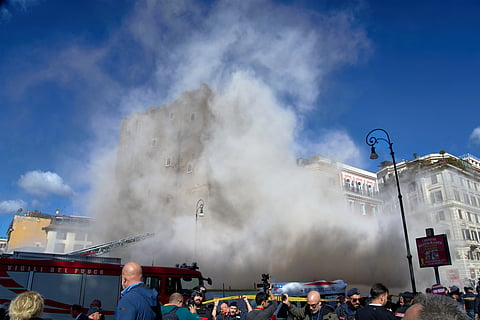
Rescuers faced a complex task as they tried to reach the trapped worker through a first-floor window. However, they were forced to retreat in a cloud of debris as the structure continued to give way.
Another approach using two ladders was also aborted, and a drone was deployed instead.
As dusk approached, firefighters used a crane to lift giant tubes to suck rubble out of the second-floor window. They continued working late into the night.
“The operation lasted a long time because every time a part of the body was freed, additional rubble covered it,” Giannini said.
Rome’s Mayor, Roberto Gualtieri, told reporters earlier that the worker had been speaking to rescuers and using an oxygen mask. He added that the team was working with extreme caution in “a very delicate extraction operation” to avoid further collapses.
Three workers were rescued unharmed after the initial midday incident, said firefighter spokesperson Luca Cari. Another worker, aged 64, was hospitalised in critical condition; RAI reported that he was conscious and had suffered a broken nose.
No firefighters were injured during the operation.
The Torre dei Conti was built in the 13th century by Pope Innocent III as a residence for his family. The tower was damaged in a 1349 earthquake and suffered further collapses in the 17th century.
Hundreds of tourists gathered to watch as firefighters used a mobile ladder to bring a stretcher to the upper level of the Torre dei Conti during the first rescue attempt. Suddenly, another part of the structure crumbled, sending up a cloud of debris and forcing firefighters to quickly descend.
The first collapse struck the central buttress on the southern side of the structure and caused an underlying sloped base to fall. The second damaged part of the stairwell and roof, cultural heritage officials said in a statement.
The tower, which has been closed since 2007, is undergoing a €6.9 million (nearly USD 8 million) restoration that includes conservation work, the installation of electrical, lighting and water systems, and a new museum installation dedicated to the most recent phases of the Roman Imperial Forum, officials said.
Before the latest phase began in June, structural surveys and load tests were carried out “to verify the stability of the structure, which confirmed the safety conditions necessary” to proceed with the work, including asbestos removal, officials added.
The current phase of work, costing €400,000 (around USD 460,000), was almost complete.
