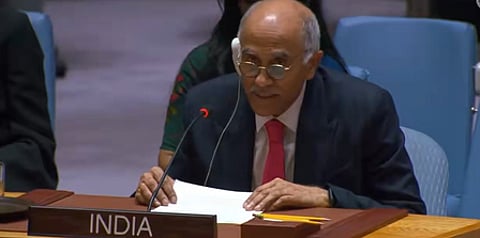

NEW DELHI: India has flagged United Nations Security Council member with “vested interests” chairing subsidiary bodies, in an oblique reference to Pakistan co-chairing the counter-terrorism panel, citing conflicts of interest, in an oblique reference to Pakistan.
At a Council debate on working methods, India’s Permanent Representative to the UN, P Harish called for greater transparency and objectivity in the selection of chairs for UNSC subsidiary bodies and “pen-holderships”.
“Selection of Chairs of subsidiary bodies and pen-holderships needs to be carried out in a more transparent, objective and time bound manner.
“Chairs and pen-holderships are privileges that come with major responsibilities. Discussions in the Council on distribution of Chairs and pen-holderships must prevent Council members with vested interests from being accorded these privileges. Obvious and outright conflicts of interest can have no place in the Council,” he said.
Harish hit out at what he described as a shroud of secrecy over how the Council rejects proposals to designate terrorists.
“There must be greater transparency in the functioning of the subsidiary organs. A case in point is the manner in which listing requests are rejected. Unlike de-listing decisions, these are done in a rather obscure manner, with member states that are not on the Council not being privy to details,” Harish pointed out.
Without naming the country involved, Harish’s remarks were clearly aimed at the member currently chairing the 1988 Taliban sanctions committee, which oversees travel bans on Taliban officials.
Pakistan member also co-chairs the counter-terrorism committee while maintaining its own complex equations with groups under UN sanctions. India has long maintained that terrorism is an instrument of Pakistan’s state policy.
The envoy also questioned the continued existence of certain UN mandates that India believes have outlived their relevance, a thinly veiled reference to the UN Military Observer Group in India and Pakistan (UNMOGIP).
“Continuation of mandates that have outlived their utility for narrow political interests must not be allowed,” he said, warning that such missions drain resources in a constrained budget environment. He urged the Council to introduce sunset clauses for outdated peacekeeping operations.
